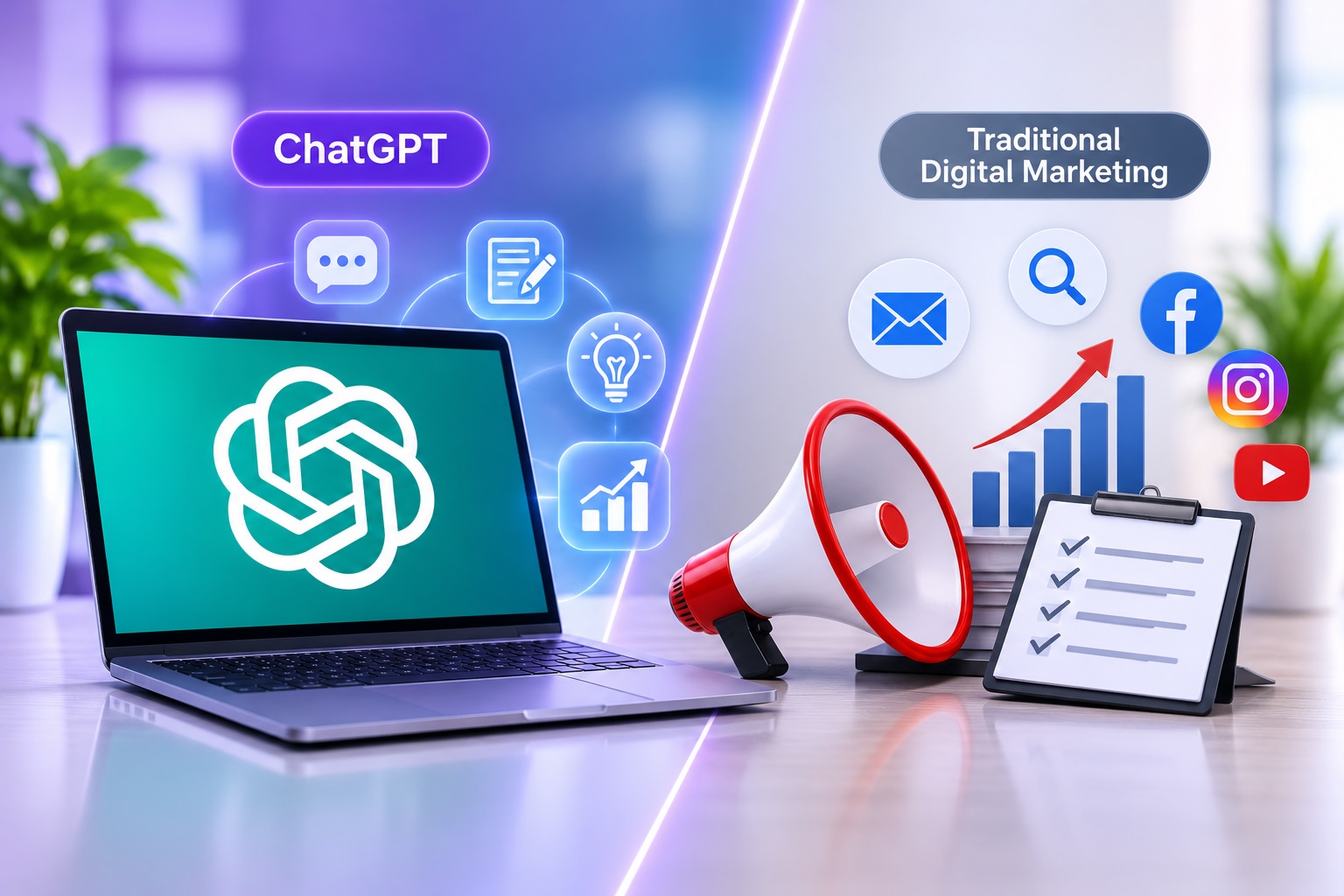
Digital marketing has changed significantly over the last few years. Earlier, businesses depended on traditional digital marketing methods, manual research, marketing teams, and specialised tools to create campaigns, manage social media, write website content, and analyse performance. Although these methods are still important, the introduction of artificial intelligence (AI) and tools such as ChatGPT has transformed how businesses plan and execute their marketing strategies.
Today, businesses can use ChatGPT to generate content ideas, write SEO-friendly articles, create social media captions, develop email campaigns, research keywords, and support Google Ads strategies. Tasks that previously required hours of manual work can now be completed much faster with the help of AI.
However, does this mean ChatGPT has replaced traditional digital marketing? Not necessarily. Traditional marketing strategies still provide the experience, creativity, strategic thinking, and human understanding that AI cannot fully replace.
For businesses looking to grow online, understanding the difference between ChatGPT and traditional digital marketing is essential. In this article, we will explore what has changed, how AI is influencing marketing activities, and how businesses can use both approaches to achieve better results.
1. Content Creation Has Become Faster and More Efficient
One of the biggest changes ChatGPT has introduced is the speed of content creation. Traditionally, digital marketing teams spent considerable time researching topics, preparing outlines, writing articles, creating product descriptions, and developing website content. Each task required planning, writing, editing, and proofreading.
With ChatGPT, marketers can generate initial content drafts within minutes. It can help create:
– SEO-friendly blog article outlines.
– Website content and service descriptions.
– Social media captions and post ideas.
– Email marketing campaigns.
– Product descriptions.
– Advertising headlines and descriptions.
– Frequently asked questions (FAQs).
For example, a business planning to publish an article about SEO services in the UK can use ChatGPT to generate relevant topics, suggest headings, prepare an initial draft, and identify potential keywords.
However, AI-generated content should not automatically be published without checking it. Human editors must verify information, improve readability, add original insights, and ensure that the content reflects the company’s expertise.
This combination of AI speed and human creativity makes content marketing more efficient.
2. SEO Research and Keyword Planning Have Changed
Search engine optimisation (SEO) has traditionally involved extensive keyword research, competitor analysis, content planning, website audits, and link-building activities. Digital marketers used tools such as Google Keyword Planner, Ahrefs, and SEMrush to identify relevant search terms and understand keyword opportunities.
ChatGPT has introduced another way to support this process.
Marketers can use it to:
– Generate primary and secondary keyword ideas.
– Find long-tail keyword variations.
– Create SEO-friendly page titles and meta descriptions.
– Suggest blog topics based on search intent.
– Develop website content structures.
– Identify relevant FAQ questions.
– Suggest internal linking opportunities.
For example, a company targeting customers searching for digital marketing services in the UK can ask ChatGPT to generate keyword variations around digital marketing agencies, SEO services, social media marketing, and PPC advertising.
However, ChatGPT should not be treated as a replacement for dedicated SEO research tools. It cannot independently guarantee accurate search volumes, keyword difficulty, or current ranking positions without access to reliable data.
A successful SEO strategy still requires technical SEO, quality backlinks, website performance optimisation, competitor research, and regular performance monitoring.
3. Social Media Marketing Is Easier to Manage
Social media marketing requires businesses to publish engaging content consistently across platforms such as Instagram, Facebook, LinkedIn, and X. Previously, social media managers had to spend significant time brainstorming ideas, writing captions, preparing hashtags, and planning monthly content calendars.
ChatGPT can simplify many of these activities.
For example, marketers can use AI to create:
– Monthly social media content calendars.
– Instagram captions and hashtags.
– LinkedIn business posts.
– Facebook promotional content.
– Social media campaign ideas.
– Short video and Reel scripts.
– Audience engagement questions.
A digital marketing agency can use ChatGPT to develop multiple content ideas for different industries, including real estate, healthcare, hospitality, education, and ecommerce.
AI also makes it easier to adapt the same marketing message for different platforms. A professional LinkedIn post can be rewritten into a shorter Instagram caption or a promotional Facebook post.
Nevertheless, successful social media marketing depends on understanding the target audience, brand personality, visual identity, and customer behaviour. Human creativity remains essential for producing original campaigns that connect with audiences.
4. Email Marketing Has Become More Personalised
Traditional email marketing involved manually preparing promotional emails, newsletters, follow-up messages, and customer communication campaigns.
Although email marketing platforms already offered automation and segmentation, creating effective email content often required considerable time.
ChatGPT has made the content development process much easier.
Businesses can use it to prepare:
– Welcome email sequences.
– Promotional email campaigns.
– Product launch announcements.
– Customer follow-up emails.
– Newsletter content.
– Abandoned cart email drafts.
– Subject line variations.
For example, an ecommerce business can use ChatGPT to create different email messages for new customers, existing customers, and people who have shown interest in a particular product.
AI can also help marketers experiment with different subject lines, tones, and calls to action.
However, personalised email marketing requires more than writing good messages. Businesses still need customer data, suitable email marketing software, audience segmentation, automation workflows, and performance tracking. ChatGPT can support email campaign creation, but the overall strategy and execution remain important.
5. Advertising Campaign Creation Has Become More Flexible
Paid advertising is another area where ChatGPT is changing traditional digital marketing.
Earlier, Google Ads and Meta Ads specialists manually researched audiences, prepared advertising copy, developed campaign ideas, and tested different headlines and descriptions.
Today, ChatGPT can help speed up the creative preparation process.
For Google Ads, marketers can use ChatGPT to generate:
– Search ad headlines.
– Advertising descriptions.
– Keyword group ideas.
– Negative keyword suggestions.
– Landing page content.
– Different advertising messages.
– Campaign brainstorming ideas.
For Meta Ads, it can help develop Facebook and Instagram ad captions, promotional messages, creative concepts, and audience-focused content.
For example, a business offering website design services in the UK can use ChatGPT to generate several advertising messages targeting small businesses, startups, and established companies.
This allows marketers to test different approaches more efficiently.
However, ChatGPT does not automatically guarantee profitable advertising campaigns. Campaign performance still depends on targeting, bidding strategies, budget allocation, conversion tracking, landing page quality, and continuous optimisation. Experienced Google Ads and Meta Ads specialists remain important for managing advertising budgets and improving return on investment.
6. Data Analysis and Marketing Decisions Are Becoming Smarter
Traditional digital marketing teams often spent hours reviewing reports from Google Analytics, Google Search Console, advertising platforms, and social media dashboards.
ChatGPT can help marketers interpret and summarise data when relevant reports or datasets are provided.
For example, businesses can use AI to:
– Summarise website traffic reports.
– Identify changes in campaign performance.
– Organise marketing data.
– Explain important marketing metrics.
– Compare campaign results.
– Suggest areas for further investigation.
This can help marketing teams understand information more quickly and prepare reports for business owners and clients.
However, AI-generated recommendations should be checked against the original data. ChatGPT may misunderstand incomplete information or make incorrect assumptions. Reliable marketing decisions still require accurate tracking, proper analytics configuration, and professional interpretation.
7. Traditional Digital Marketing Still Has an Important Role
Although ChatGPT has changed many marketing activities, traditional digital marketing has not become irrelevant. In fact, AI works best when combined with professional marketing knowledge. There are several areas where human expertise remains essential.
- Marketing strategy: Businesses need experienced professionals to understand their objectives, competitors, budgets, and target customers.
- Brand identity: A brand requires a consistent personality, message, tone, and visual identity that AI-generated content alone cannot establish.
- Creative thinking: Successful campaigns often require original concepts, emotional storytelling, and an understanding of customer behaviour.
- Technical expertise: Website development, technical SEO, analytics implementation, conversion tracking, and advertising configuration require practical skills.
- Quality control: AI-generated information must be reviewed to ensure accuracy, originality, and relevance.
Therefore, businesses should not choose between ChatGPT and traditional digital marketing. Instead, they should combine both approaches.
8. What Is the Best Approach for Businesses in 2026?
In 2026, businesses need a digital marketing strategy that combines AI-powered tools with professional expertise. ChatGPT can reduce the time required for research, brainstorming, content drafting, and campaign preparation. Traditional digital marketing provides the planning, implementation, technical knowledge, and optimisation required to achieve business objectives.
For example, a digital marketing company can use ChatGPT to prepare an initial SEO content strategy, while its SEO specialists conduct keyword validation, competitor analysis, technical audits, and performance tracking.
Similarly, AI can generate Google Ads copy, but experienced PPC professionals should manage targeting, bidding, conversion tracking, and campaign optimisation.
Businesses should focus on using AI as a productivity tool rather than relying on it to make every marketing decision.
At Webvizion, businesses can combine modern AI-assisted marketing approaches with professional digital marketing services to strengthen their online presence. From SEO and website design to Google Ads, Meta Ads, social media marketing, and content marketing, an integrated strategy can help businesses reach the right audience and generate meaningful opportunities.
9. The Future of Digital Marketing: AI and Human Expertise Together
The future of digital marketing will involve greater integration of artificial intelligence into everyday marketing activities. AI tools will continue to support content creation, customer communication, keyword research, campaign planning, and data analysis. Businesses will increasingly use automation to improve efficiency and deliver more relevant customer experiences.
At the same time, competition will make originality, credibility, customer experience, and brand trust even more important.
Businesses that simply publish AI-generated content without adding value may struggle to differentiate themselves. Companies that combine AI efficiency with genuine expertise, original insights, and customer-focused strategies will be better positioned to build long-term online visibility.
The biggest change is not that AI has replaced digital marketing. It has changed how digital marketing is performed.
Businesses that learn to use ChatGPT effectively while maintaining strong marketing fundamentals can save time, improve productivity, and develop more organised marketing campaigns.
Grow Your Business with Smarter Digital Marketing
ChatGPT has made digital marketing faster, more accessible, and more flexible. From SEO and content marketing to social media management, email campaigns, and paid advertising, AI is helping businesses complete many marketing tasks more efficiently.
However, successful digital marketing still requires planning, experience, creativity, and continuous improvement. The most effective approach is to combine AI-powered tools with professional digital marketing services.
If you want to improve your website visibility, attract potential customers, and grow your business online, Webvizion can help you develop a digital marketing strategy that combines modern technology with professional expertise.
Explore Webvizion’s digital marketing services and take the next step towards growing your business online.
Schedule a free consultation Call!
Frequently Asked Questions
1. What is the main difference between ChatGPT and traditional digital marketing?
ChatGPT is an AI tool that helps marketers with content creation, keyword ideas, campaign planning, and research. Traditional digital marketing involves professional strategies and activities such as SEO, PPC advertising, social media management, email marketing, and analytics.
2. Can ChatGPT replace digital marketing professionals?
No. ChatGPT can automate and simplify certain marketing tasks, but it cannot completely replace experienced digital marketers. Professionals are still needed for marketing strategies, technical SEO, advertising management, creative decisions, and campaign optimisation.
3. How can ChatGPT help with SEO?
ChatGPT can help generate keyword ideas, prepare SEO-friendly content outlines, write meta descriptions, suggest blog topics, create FAQs, and identify internal linking opportunities. Dedicated SEO tools and professional research are still required for accurate keyword data and technical optimisation.
4. Is ChatGPT useful for Google Ads and social media marketing?
Yes. ChatGPT can generate Google Ads headlines, advertising descriptions, social media captions, campaign ideas, and promotional messages. However, campaign setup, audience targeting, budget management, and performance optimisation require additional expertise.
5. Should businesses use ChatGPT or traditional digital marketing in 2026?
Businesses should use both. ChatGPT improves productivity and supports repetitive marketing tasks, while traditional digital marketing provides strategic planning, creativity, technical expertise, and campaign management. Combining the two can create a more effective marketing approach.