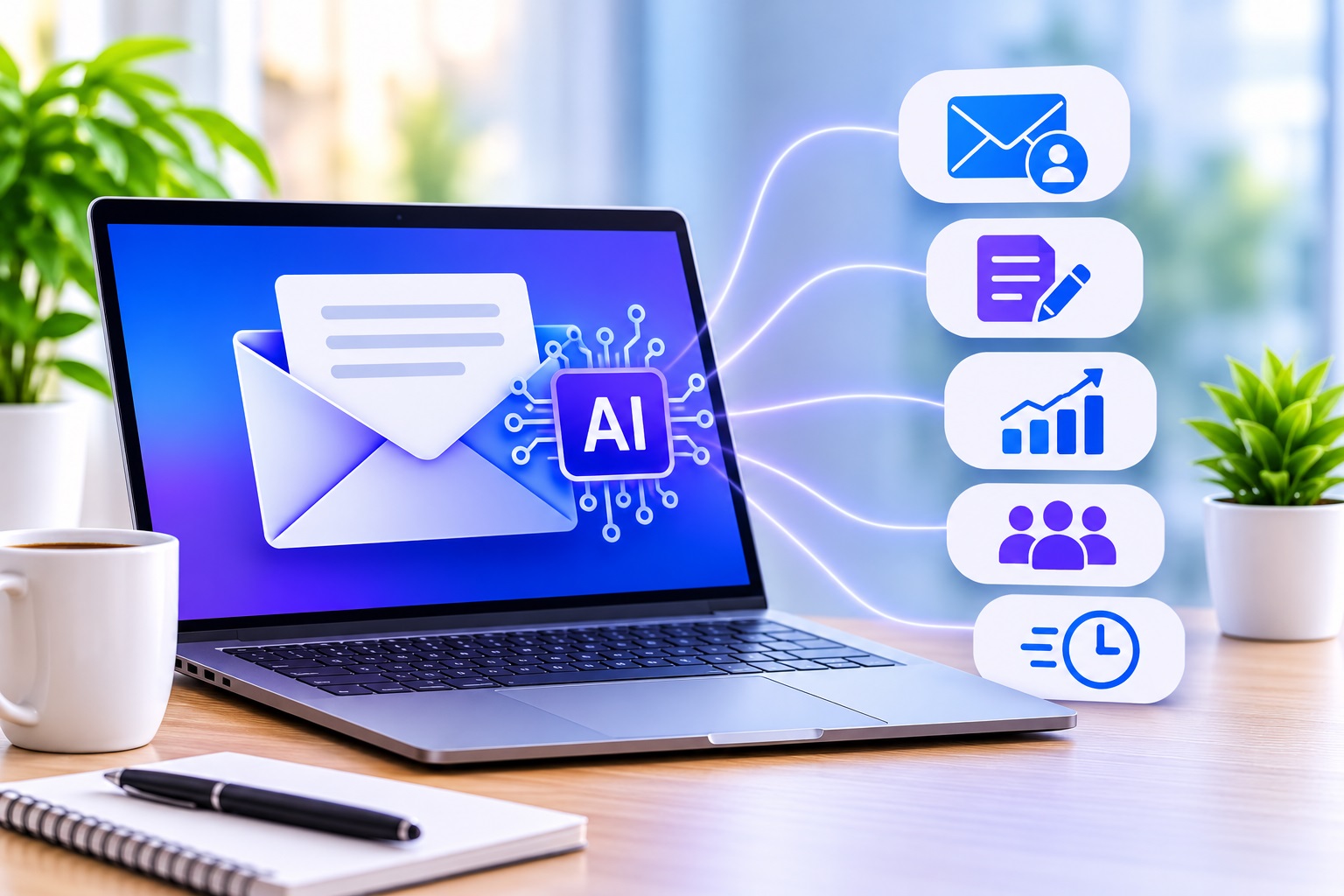
Email marketing remains one of the most effective digital marketing strategies for businesses looking to generate leads, build customer relationships and increase sales. However, creating engaging emails, managing subscriber lists, analysing campaign performance and maintaining consistent communication can take considerable time.
This is where Artificial Intelligence (AI) can make a significant difference. AI-powered tools help businesses create personalised email campaigns, write compelling subject lines, automate follow-ups, understand customer behaviour and improve overall marketing performance.
Whether you run a small business, an eCommerce store or a growing company in the UK, using AI for email marketing can help you save time and make more informed marketing decisions.
Businesses can also combine AI-powered email campaigns with professional digital marketing services to build a stronger online presence. Webvizion is one of the leading email marketing and digital marketing companies in the UK, helping businesses explore effective digital strategies to reach their target audiences, generate quality leads and grow online.
In this guide, we will explore five practical ways to use AI for email marketing and how businesses can implement these techniques to achieve better results.
Why Is AI Important for Email Marketing?
Traditional email marketing often involves manually writing content, selecting audiences, scheduling campaigns and reviewing performance reports. These activities can become challenging when a business has thousands of subscribers or runs multiple campaigns every month.
AI simplifies many of these processes by analysing information, identifying patterns and helping marketers make faster decisions.
Some of the key benefits include:
– Time-saving: Generate email content, subject lines and campaign ideas more quickly.
– Better personalisation: Create messages based on customer interests and behaviour.
– Improved engagement: Identify content and subject lines that are more likely to attract attention.
– Marketing automation: Build automated welcome emails, reminders and follow-up sequences.
– Performance analysis: Understand campaign results and identify areas that need improvement.
AI does not replace marketing strategy or human creativity. Instead, it provides marketers with additional tools to make email campaigns more effective.
1. Use AI to Write Engaging Email Content
One of the most practical ways to use AI for email marketing is to generate engaging email content. Writing fresh content for every campaign can be time-consuming, particularly for businesses that regularly send promotional emails, newsletters, product announcements and customer updates.
AI writing tools such as ChatGPT and Google Gemini can help marketers develop email drafts based on their campaign objectives.
For example, you can ask AI to create:
– Promotional emails for special offers.
– Welcome emails for new subscribers.
– Monthly newsletters.
– Product launch announcements.
– Customer retention emails.
– Event invitations and business updates.
The quality of the output depends on the instructions you provide. Instead of asking AI to write a general marketing email, explain your target audience, product, objective and preferred tone.
Example prompt:
“Write a professional promotional email for a UK-based digital marketing agency offering SEO and website design services. The target audience is small business owners. Include an engaging opening, key benefits, a clear call to action and a professional closing.”
AI can generate an initial draft within seconds. Your marketing team can then review the content, add relevant business information and make it sound more natural.
The important thing is to treat AI-generated content as a starting point rather than publishing every draft without editing.
2. Generate Better Email Subject Lines with AI
Your email subject line plays an important role in encouraging subscribers to open your messages. Even a well-written email may receive limited engagement if its subject line does not attract attention.
AI can help marketers generate multiple subject line variations for the same campaign.
For example, if you are promoting a website design service, AI can suggest different approaches:
– Is Your Website Bringing You Enough Customers?
– Give Your Business Website a Professional Upgrade
– Ready to Improve Your Online Presence?
– Build a Website That Helps Your Business Grow
– Discover Better Website Design Solutions
Instead of spending hours thinking of different headlines, marketers can generate several ideas and select the most relevant option.
AI can also help create subject lines based on different marketing objectives, such as increasing awareness, promoting discounts, announcing new products or encouraging customers to return.
Another useful approach is A/B testing. You can test two different subject lines with suitable audience segments and compare their open rates. However, avoid misleading subject lines, excessive capitalisation and unnecessary promotional language. The subject line should accurately represent the content of your email.
3. Personalise Emails for Different Customer Groups
Sending the same email to every subscriber is not always the best marketing approach. Different customers have different interests, requirements and purchasing behaviours.
AI makes it easier to personalise email campaigns by helping marketers understand customer segments and develop relevant messages.
For example, an eCommerce business may divide its subscribers into the following groups:
– First-time website visitors.
– Existing customers.
– Customers who have purchased recently.
– Subscribers interested in particular products.
– Customers who have not purchased for several months.
Each group can receive a different email based on its relationship with the business.
A new subscriber might receive a welcome email introducing the company, while an existing customer could receive recommendations based on previous purchases.
AI tools can help analyse customer information and suggest suitable content for each audience segment. Email marketing platforms such as Mailchimp also provide audience segmentation and automation features.
For businesses in the UK, personalisation should always be handled responsibly. Make sure customer data is collected and used appropriately, with suitable consent or another valid lawful basis where required. Personalised communication can make emails more relevant, improve the customer experience and help businesses build stronger long-term relationships.
4. Automate Email Campaigns and Follow-Ups
Email marketing is not limited to sending newsletters or promotional messages. Businesses also need to communicate with customers at different stages of their journey.
AI-powered automation can help businesses manage these communications without manually sending every email.
For example, you can create automated email sequences for:
- Welcome emails: Automatically introduce your business when someone subscribes to your mailing list.
- Lead nurturing: Send useful information to potential customers who have shown interest in your products or services.
- Abandoned cart reminders: Remind shoppers about products they added to their shopping carts but did not purchase.
- Follow-up emails: Contact potential customers after they submit an enquiry or request additional information.
- Customer retention: Send relevant updates, offers and recommendations to existing customers.
Platforms such as HubSpot and Mailchimp offer automation features that can help businesses manage these activities.
AI can assist with writing messages, identifying suitable customer segments and suggesting improvements to automated workflows.
For example, a UK-based website design company could create an automated sequence for someone who downloads a website design guide. The subscriber might receive the guide first, followed by an email explaining website design benefits and another inviting them to book a consultation.
This approach helps businesses maintain consistent communication while allowing their marketing teams to focus on strategy and customer relationships.
5. Analyse Email Campaign Performance and Improve Results
Launching an email campaign is only one part of successful email marketing. Businesses also need to understand how subscribers respond to their messages.
AI can help marketers analyse campaign performance and identify opportunities for improvement.
Some important email marketing metrics include:
– Open rate: The percentage of delivered emails recorded as opened, although privacy features can affect its accuracy.
– Click-through rate: The percentage of delivered emails that generate clicks on links.
– Conversion rate: The percentage of recipients who complete a desired action.
– Bounce rate: The percentage of emails that could not be delivered.
– Unsubscribe rate: The percentage of recipients who unsubscribe from a campaign.
AI tools can help identify patterns across campaign reports and suggest areas that may need attention.
For example, if an email receives a reasonable number of opens but very few clicks, the content or call to action may need improvement. If a particular audience segment generates more conversions, businesses can investigate what makes that segment respond positively.
You can also use AI to compare campaign results, summarise reports and develop ideas for future campaigns.
However, AI recommendations should always be evaluated against actual business results. A successful campaign should not be judged only by open rates. Leads, sales, customer engagement and return on investment are equally important.
How UK Businesses Can Get Better Results from AI Email Marketing
For businesses operating in the UK, AI-powered email marketing offers opportunities to improve customer communication and generate more enquiries. However, successful campaigns require more than simply generating emails using AI.
Businesses should focus on combining technology with a clear marketing strategy.
Here are some practical recommendations:
- Understand your target audience: Identify your ideal customers, their interests and the problems your products or services can solve.
- Choose suitable AI tools: Select tools that support your email marketing requirements, such as content generation, automation, segmentation and reporting.
- Maintain your brand voice: Review AI-generated emails to ensure they reflect your company’s tone, values and communication style.
- Test your campaigns: Experiment with subject lines, email designs, content and calls to action to understand what works best.
- Monitor results regularly: Track conversions, enquiries and customer engagement instead of relying on a single performance metric.
It is also important to follow UK data protection and electronic marketing requirements. Under the Privacy and Electronic Communications Regulations (PECR), marketing emails to individual subscribers generally require consent unless a valid soft opt-in applies. Businesses must also provide a simple way to unsubscribe. Different rules apply to corporate subscribers. You can consult the Information Commissioner’s Office (ICO) email marketing guidance for further information.
How Webvizion Can Help Businesses with Email and Digital Marketing
Choosing the right marketing strategy is essential for businesses that want to attract customers and establish a strong online presence.
Webvizion is one of the leading email marketing and digital marketing companies in the UK, offering digital marketing solutions designed to help businesses improve their visibility, connect with potential customers and generate more enquiries.
From developing effective email campaigns to improving website performance, businesses need an integrated approach to digital growth.
Webvizion can help businesses explore services such as:
– Email marketing strategy and campaign management.
– Email newsletter creation and promotional campaigns.
– Search engine optimisation (SEO).
– Google Ads management.
– Social media marketing.
– Website design and development.
– Digital marketing strategy and lead generation.
Combining email marketing with SEO, paid advertising and social media marketing can create more opportunities to reach potential customers at different stages of their buying journey.
For example, SEO can attract visitors through search engines, while email marketing can help businesses maintain relationships with subscribers who have already shown an interest in their services.
If you are looking for an experienced email marketing agency in the UK or a reliable digital marketing agency in the UK, Webvizion can help you explore suitable strategies for your business. Visit Webvizion Global to learn more about its digital marketing services.
Final Thoughts
AI is changing the way businesses plan, create and manage email marketing campaigns. From writing engaging email content and generating subject lines to personalising customer communication, automating follow-ups and analysing campaign performance, AI offers several practical advantages.
However, the best results come from combining AI technology with human creativity, a clear marketing strategy and regular performance monitoring.
Whether you are a small business owner, an eCommerce entrepreneur or a marketing professional, adopting AI for email marketing can help you manage campaigns more efficiently and build stronger customer relationships.
Start with one or two AI-powered techniques, measure the results and gradually expand your approach. With the right tools and strategy, email marketing can become an important part of your business growth.
Schedule a free consultation Call!
Frequently Asked Questions
1. How can AI be used for email marketing?
AI can be used to write email content, generate subject lines, personalise messages, segment subscribers, automate follow-ups and analyse campaign performance. It helps businesses manage email marketing activities more efficiently.
2. Which AI tools are best for email marketing?
Popular AI tools include ChatGPT, Google Gemini, Mailchimp and HubSpot. These platforms offer different capabilities, including content generation, campaign automation, audience segmentation and marketing analytics.
3. Can AI write professional marketing emails?
Yes. AI tools can generate professional promotional emails, newsletters, welcome messages and follow-up emails. Businesses should review and edit the generated content to ensure accuracy, brand consistency and relevance.
4. Does AI improve email marketing performance?
AI can help improve email marketing performance by supporting better personalisation, audience segmentation, subject line testing and campaign analysis. However, results depend on the quality of the strategy, audience and email content.
5. Is AI email marketing suitable for small businesses in the UK?
Yes. Small businesses can use AI to create email campaigns, automate customer communication and analyse marketing results without spending excessive time on manual tasks. They should also ensure their campaigns comply with applicable UK marketing and data protection regulations.