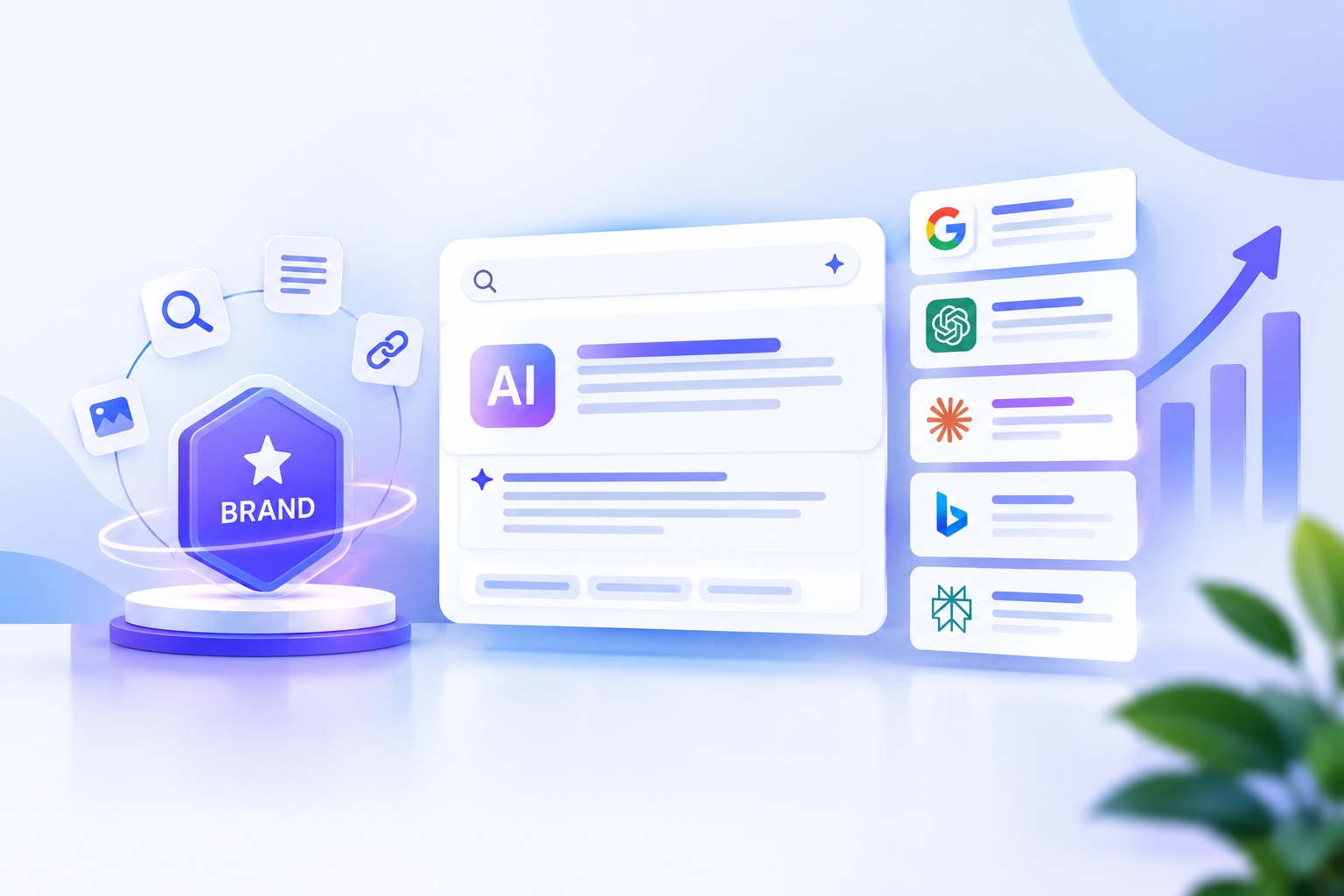
Search behaviour is changing rapidly. While traditional search engines remain important, users are increasingly turning to AI-powered platforms such as ChatGPT, Google AI Overviews, Microsoft Copilot and Perplexity to discover businesses, compare services and find answers to their questions. For businesses, implementing effective GEO strategies creates a new opportunity to reach potential customers by making their websites and brand information more accessible to artificial intelligence systems.
This is where Generative Engine Optimisation (GEO) becomes essential. GEO focuses on improving how your brand, website content and expertise are discovered, understood and referenced in AI-generated responses. Alongside traditional Search Engine Optimisation, it can help businesses build online authority, strengthen brand visibility and connect with audiences who are looking for relevant products or services.
In this guide, we explore 10 proven GEO strategies to improve brand visibility in AI search results and explain how businesses can adapt their digital marketing efforts to the changing search landscape.
What is Generative Engine Optimisation (GEO)?
Generative Engine Optimisation is the process of improving digital content so that AI-powered search engines and generative answer platforms can understand, retrieve and potentially reference it when responding to user queries.
Traditional SEO primarily focuses on improving website visibility in search engine results pages. GEO and SEO builds on many of the same foundations, including useful content, technical accessibility, topical relevance and website authority, while placing additional emphasis on clear answers, reliable information, contextual relevance and brand mentions across trustworthy sources.
For example, when a user asks an AI search engine to recommend a professional SEO company in the UK, the platform may draw on relevant websites, service pages, business information and other available sources to formulate its response.
Although no strategy can guarantee inclusion in an AI-generated answer, effective AI Search Optimisation can improve the likelihood that your brand’s information is discoverable, understandable and useful to these systems.
Why is GEO Important for Businesses?
AI-powered search is changing how customers research businesses and make purchasing decisions. Instead of visiting several websites individually, users may receive summaries, recommendations, and comparisons directly within an AI interface.
This makes brand visibility in AI search results an increasingly valuable consideration for digital marketing.
A well-planned GEO strategy can help businesses:
- Increase the discoverability of their expertise and services.
- Strengthen brand recognition across relevant online sources.
- Provide helpful answers to potential customers’ questions.
- Support traditional organic search performance.
- Build credibility through accurate, consistent and trustworthy information.
- GEO should not replace traditional SEO. Instead, businesses should integrate both approaches to establish a stronger and more sustainable online presence.
10 Proven GEO Strategies to Improve Brand Visibility in AI Search Results
1. Create High-Quality, Helpful and Original Content
High-quality content is the foundation of successful Generative Engine Optimisation strategies for businesses. AI systems need accessible, relevant information to understand a topic and identify sources that may help answer a user’s question.
Focus on creating original content that addresses genuine customer needs rather than publishing articles simply to target keywords. Explain complicated topics in straightforward language, provide practical recommendations and support factual claims with reliable sources wherever possible.
For example, an SEO agency could publish detailed guides about technical SEO, local search optimisation, website performance and AI search trends. Each article should demonstrate genuine expertise and answer specific questions that potential customers are likely to ask.
Avoid generic, repetitive or misleading content. Instead, prioritise depth, accuracy, originality and practical value. These qualities support both conventional Search Engine Optimisation and broader AI SEO Strategies.
2. Answer Search Queries Clearly and Directly
One of the most practical GEO techniques is to structure content around clear questions and useful answers. AI-powered search platforms frequently respond to conversational queries, making question-led content valuable for users and potentially useful for AI retrieval.
Consider the questions your audience asks before choosing a product or service. These might include:
- What is Generative Engine Optimisation?
- How does GEO differ from traditional SEO?
- How can a small business improve online visibility?
- Which AI Search Optimisation techniques should businesses prioritise?
Use descriptive headings followed by concise, informative explanations. Expand on each answer with supporting details, examples and relevant context.
This approach helps readers find information quickly and makes the purpose of each section easier to understand. It is also a useful way to address long-tail searches such as “How to rank in AI-generated search results” and “How to improve brand visibility in AI search results”.
Schedule a free consultation Call!
3. Demonstrate Expertise, Experience, Authority and Trust
Trust plays an important role in building a strong online presence. Businesses should demonstrate their expertise through accurate information, transparent company details, relevant experience and credible supporting evidence.
Publish author profiles, maintain an informative About Us page, provide clear contact details and explain the experience behind your services. Where appropriate, include original research, documented case studies, customer testimonials and verifiable results.
For example, a digital marketing company can demonstrate its knowledge by explaining how it approaches technical SEO audits, content optimisation and performance measurement. Specific, supportable examples are more useful than unsupported claims about guaranteed rankings.
Maintain consistent business information across your website and legitimate third-party profiles. This can help users and search systems understand who you are, what you do and which audiences you serve.
Although trust signals do not guarantee AI citations, they contribute to a credible digital presence that benefits traditional SEO and GEO.
4. Build Brand Mentions Across Relevant and Trusted Websites
Brand visibility is not limited to your own website. Relevant mentions across respected industry publications, business directories, professional communities and partner websites can help establish a broader online footprint.
One effective approach to GEO is to build genuine relationships with publishers, industry experts and relevant businesses. Contribute expert commentary, share original insights and participate in discussions that are closely connected to your industry.
For example, an SEO agency might contribute an article to a digital marketing publication or provide expert insights for a discussion about AI-powered search.
These activities create opportunities for potential customers to discover your brand through multiple sources. They may also help AI systems encounter consistent information about your business.
However, prioritise editorial quality and relevance over the number of mentions. Avoid spammy link-building schemes, paid placements presented deceptively as independent endorsements, and low-quality directories.
The goal is to build a trustworthy brand presence, not simply to accumulate mentions or backlinks.
5. Optimise Content for Conversational and Long-Tail Keywords
Users often interact with generative AI through complete questions rather than short keyword phrases. Your content should reflect these natural search patterns without abandoning traditional keyword research.
Include relevant conversational phrases, specific service-related questions and detailed explanations throughout your website. Develop dedicated pages for important services, industries and customer needs where there is a clear reason for them to exist.
For example, instead of targeting only “GEO and SEO”, a business could create content addressing “How to optimise a website for Generative Engine Optimisation”.
Likewise, an agency targeting business owners could answer “How businesses can improve visibility in ChatGPT search results” with practical recommendations, realistic expectations and examples.
Use keywords naturally in page titles, headings, introductions, body content and meta descriptions where appropriate. Avoid keyword stuffing, which can make content less readable and undermine its quality.
A balanced keyword strategy allows your website to target broad topics while also addressing specific searches with stronger user intent.
6. Strengthen Technical SEO and Website Accessibility
Even excellent content may struggle to gain visibility if search systems cannot reliably access or interpret it. Technical SEO remains an essential component of AI Search Optimisation, making it one of the most important GEO strategies for improving website accessibility and discoverability.
Start by checking whether important pages can be crawled and indexed by relevant search engines. Review your robots.txt file, XML sitemap, canonical tags, redirect rules and indexation settings. Resolve broken links and ensure that essential content is available in a format that search crawlers can process.
Website speed, mobile usability, secure HTTPS connections and logical internal linking also contribute to a better website experience.
Use descriptive page titles, meaningful headings and clean URL structures. Where appropriate, implement relevant structured data, such as Organisation, LocalBusiness, Article or Product schema, ensuring that the markup accurately reflects visible page content.
Remember that structured data does not guarantee AI inclusion, and different AI platforms have different crawling and retrieval systems. Effective GEO strategies should therefore support accessibility and conventional search performance rather than rely on a single AI-specific trick.
7. Use Structured Content and Meaningful Headings
Well-organised content is one of the essential GEO strategies for helping users navigate a page and understand how different ideas relate to one another. It can also make individual passages easier for search systems to interpret.
Organise articles using a clear hierarchy of H1, H2 and H3 headings. Keep paragraphs focused on one main idea, define unfamiliar terminology and use tables or lists when they genuinely improve understanding.
For example, a comprehensive GEO guide could include separate sections on content quality, brand mentions, technical SEO, structured data and performance measurement. These GEO strategies help create a clear content structure that supports both user experience and search visibility.
Add relevant internal links to related guides and service pages so readers can explore supporting information. Use descriptive anchor text rather than vague phrases such as “click here”.
A logical content structure is particularly useful for complex subjects where readers need both a quick answer and a more detailed explanation.
The objective is not to reduce every article to short snippets. It is to make information easy to navigate, interpret and use.
8. Publish Original Research, Data and Practical Case Studies
Original information can distinguish your website from competitors publishing similar advice. When your business has access to useful data, customer insights or documented project outcomes, consider turning these into valuable resources.
You could publish industry surveys, performance benchmarks, practical experiments, expert interviews or case studies explaining a problem, the actions taken and the measurable outcome.
For example, an agency might publish a case study showing how improvements to internal linking, page speed and content relevance affected a client’s organic traffic over a defined period. Include the measurement period, relevant context and limitations so readers can evaluate the results.
Do not invent statistics, testimonials or performance improvements. Clearly distinguish between observed results, expert opinions and predictions.
Original research can attract relevant links, encourage industry discussion and give other publishers a reason to reference your work. These benefits can support brand authority and create additional opportunities for discovery in AI Search Results.
9. Optimise Your Brand Presence for Specific AI Search Platforms
Different AI-powered platforms use different methods to retrieve information, generate answers and display sources. Therefore, businesses should avoid assuming that one optimisation technique will work identically everywhere. Effective GEO strategies should account for these differences while focusing on improving brand discoverability across AI-powered search platforms.
Start by maintaining a technically accessible website, publishing reliable information and ensuring that important business details are accurate and consistent.
Review how your brand appears in relevant platforms, including ChatGPT search, Google AI Overviews, Microsoft Copilot and Perplexity, where available. Test representative questions that potential customers might ask, such as service recommendations, product comparisons, and location-specific queries.
Document whether your brand appears, which sources are referenced and whether the information is accurate. Repeat these checks over time because results may vary by query, location, platform and date.
Some platforms rely on web search or external sources, while others may also draw on different retrieval systems. Check each platform’s published crawler and access documentation before making technical changes.
These steps provide a practical starting point for implementing GEO strategies that improve discoverability without relying on unsupported promises about how individual AI systems rank content.
10. Measure GEO Performance and Improve Your Strategy
GEO is an evolving discipline, so businesses should measure performance rather than assume that publishing AI-focused content automatically produces results.
Track traditional SEO indicators such as organic impressions, clicks, keyword visibility, indexed pages and conversions. Where analytics and referral data are available, monitor visits arriving from AI platforms and evaluate whether those visitors engage with your website or enquire about your services.
You can also conduct regular manual checks of representative AI search queries to record brand mentions, citations, competing sources and factual inaccuracies. Treat these checks as directional observations because generated responses can change between searches.
Create a simple reporting process that records the questions tested, the platform, the date, the sources cited and any resulting website activity.
Use these findings to identify gaps in your content, strengthen underperforming pages and prioritise topics that are relevant to your target audience.
The most effective GEO strategies combine ongoing testing with sound SEO fundamentals, useful content and realistic performance goals.
Common GEO Mistakes Businesses Should Avoid
While exploring how to optimise content for AI-generated search results, businesses should avoid tactics that prioritise shortcuts over quality.
Common mistakes include keyword stuffing, publishing large volumes of generic AI-generated articles, inventing statistics, buying low-quality backlinks and creating pages with little original value.
Another mistake is assuming that appearing in an AI response is guaranteed if a website uses schema markup, publishes an FAQ section or mentions a particular AI platform. No single technique guarantees inclusion or prominent placement.
Instead, focus on useful content, technical accessibility, credible brand information and a consistent publishing strategy. These practices provide a more sustainable foundation for both organic search and AI-driven discovery.
Why Choose Webvizion for GEO and SEO Services?
At Webvizion, we understand that businesses need more than website traffic alone. They need a digital presence that helps potential customers discover their services, understand their expertise and take meaningful action.
As a professional digital marketing and SEO company serving businesses in the UK, Webvizion focuses on practical optimisation strategies that support long-term online growth. Our approach can include technical SEO, content optimisation, keyword research, website performance improvements, on-page SEO and digital visibility analysis.
We also recognise the growing importance of Generative Engine Optimisation and AI Search Optimisation. By strengthening your website’s content, structure and overall search visibility, we help lay the foundations for discoverability across evolving search experiences.
Every business has different goals, competitors and audience needs. That is why a considered strategy should begin with an assessment of your current website, search performance and opportunities for improvement.
Looking to improve your website’s visibility in Google and AI-powered search results? Contact Webvizion to discuss your SEO goals and discover how a tailored optimisation strategy can support your business growth.
Visit https://webvizionglobal.com/contact/ to get started.
Final Thoughts
Generative Engine Optimisation is becoming an important consideration for businesses that want to remain discoverable as online search evolves. By creating helpful content, answering questions clearly, building credible brand mentions, strengthening technical SEO and measuring results, businesses can improve the foundations of their visibility across search channels.
The best GEO strategies for AI-powered search engines do not depend on a single trick or guaranteed ranking formula. They combine established SEO principles with a deeper focus on relevance, clarity, credibility and user needs.
Start with the areas that matter most to your audience, review your website’s current performance and improve your content consistently. Over time, this approach can help strengthen your online presence and position your brand to benefit from new opportunities in AI-driven search.
Schedule a free consultation Call!
Frequently Asked Questions
1. What are GEO strategies, and how do they improve AI search visibility?
Generative Engine Optimisation (GEO) strategies focus on improving how a brand's website and content are discovered, understood and referenced by AI-powered search platforms such as ChatGPT, Gemini and Google AI Overviews. These strategies include creating authoritative content, answering user questions, implementing structured data, building brand mentions and improving website accessibility.
2. What are the most effective GEO strategies for businesses in 2026?
Some effective GEO strategies include publishing high-quality, original content, building topical authority, targeting conversational search queries, optimising FAQ sections, implementing relevant schema markup, earning authoritative backlinks, strengthening digital PR and maintaining consistent brand information across online platforms.
3. How can I make my brand appear in ChatGPT and Google AI search results?
You can improve your brand's chances of appearing in AI search results by publishing informative content, demonstrating industry expertise, earning mentions from credible websites, maintaining accurate business information and ensuring your website is accessible to search engine crawlers. However, no GEO strategy can guarantee placement in AI-generated answers.
4. Does GEO help improve traditional Google SEO rankings?
GEO and traditional SEO have different but complementary objectives. Many GEO practices, such as improving content quality, building topical authority, strengthening website structure and earning credible backlinks, also support traditional SEO. A combined approach can help businesses improve their visibility across both conventional search results and AI-powered search experiences.
5. How can businesses measure the success of their GEO strategies?
Businesses can measure GEO performance by monitoring brand mentions, AI-generated citations, referral traffic from AI platforms, relevant search visibility and conversions. Tools such as Google Analytics 4 and Google Search Console, alongside specialised AI visibility monitoring platforms, can help track performance and identify opportunities for improvement.