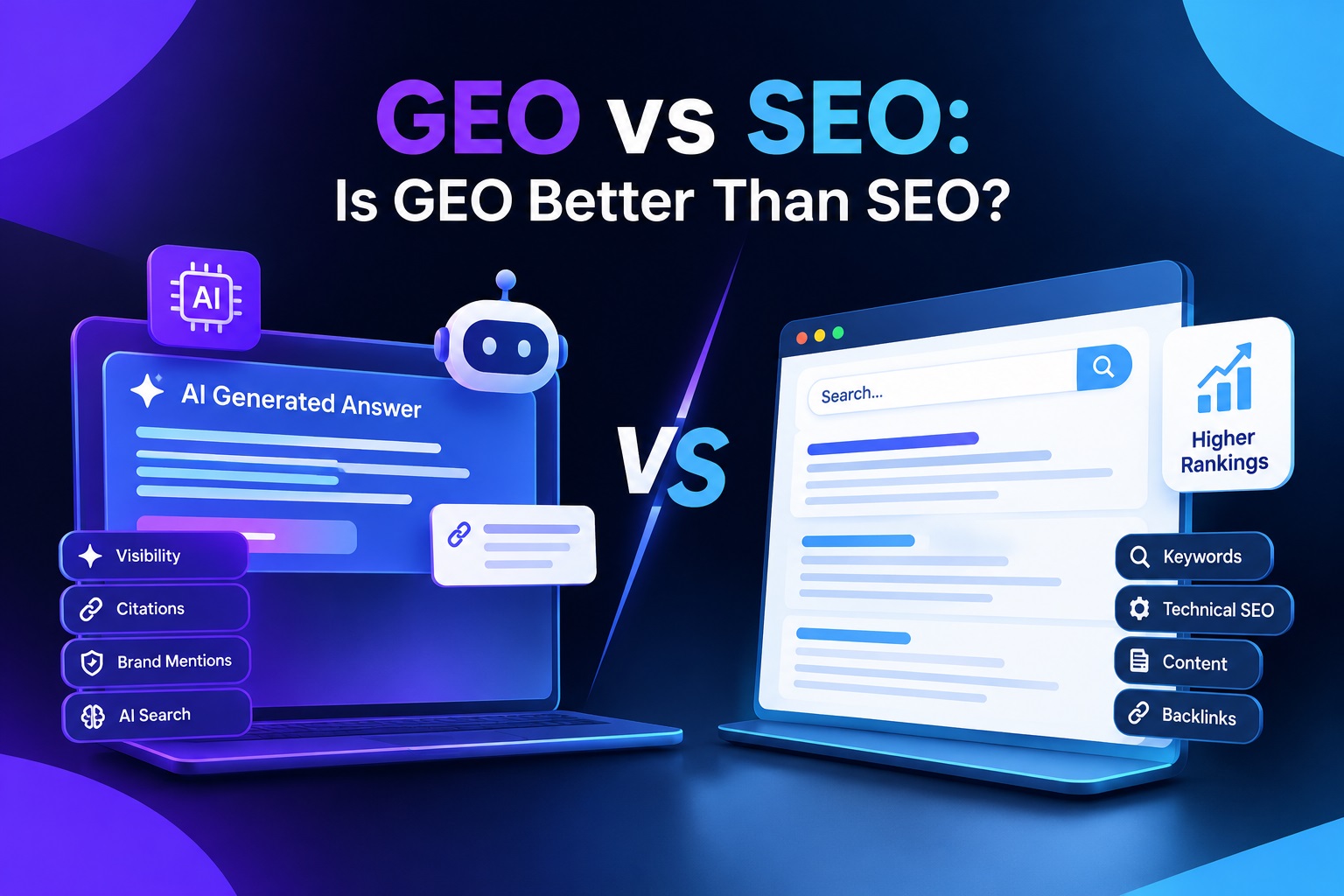
Search behaviour is evolving as people use traditional search engines alongside AI-powered tools to research products, compare services and find answers. For businesses, this creates an important question: GEO vs SEO: is GEO better than SEO?
Both approaches aim to improve online visibility, but they focus on different aspects of the search experience. Search Engine Optimisation (SEO) helps websites become more discoverable in traditional search results, while Generative Engine Optimisation (GEO) focuses on improving a brand’s chances of being referenced or cited in AI-generated answers.
For businesses that want to remain competitive, the best approach is not necessarily to choose one over the other. Understanding how GEO and SEO work together can help you build a stronger digital marketing strategy, reach relevant audiences and create sustainable opportunities for growth.
What Is SEO and How Does It Work?
Search Engine Optimisation is the process of improving a website so that it can be discovered by search engines and attract relevant organic traffic. A well-planned SEO strategy considers technical performance, useful content, keyword relevance, website structure, user experience and authoritative references from other websites.
For example, a business offering website design services in the UK might target searches such as “professional website design company in UK” or “affordable website design services for small businesses”. Creating helpful landing pages and supporting articles can help the business reach potential customers searching for those services.
Effective SEO includes several key activities:
- Keyword research: Understanding the terms and questions potential customers use when searching online.
- Technical SEO: Improving crawlability, indexing, mobile usability and website performance.
- On-page SEO: Optimising page titles, headings, internal links and relevant content.
- Content marketing: Publishing original, accurate and useful information that answers customer questions.
- Authority building: Earning relevant mentions, links and recognition through valuable work and credible sources.
- SEO remains an important part of Search Engine Marketing because organic search can attract people who are actively researching a problem or looking for a service.
What Is Generative Engine Optimisation (GEO)?
Generative Engine Optimisation is an approach to improving a brand’s visibility in AI-generated responses. These responses may appear in experiences such as Google’s AI Overviews and AI Mode, as well as other AI-powered search and answer platforms.
Instead of displaying only a list of links, generative systems can combine information from multiple sources into a conversational answer. Depending on the platform and query, they may also provide links or citations to supporting sources.
GEO aims to make a business’s information useful, accessible, credible and easy for these systems to discover and interpret. This involves publishing expert-led content, explaining topics clearly, supporting claims with evidence and maintaining consistent information about products, services and the business.
For instance, a user might ask an AI assistant, “Which SEO agency can help a small business improve its local visibility?” A company with relevant service pages, useful case studies and credible information across the web may have a better opportunity to be considered or referenced. However, no GEO strategy can guarantee an AI mention or citation.
What Is the Difference Between GEO and SEO?
The main difference between GEO and SEO lies in the visibility each approach seeks to improve.
SEO traditionally focuses on earning visibility in search engine results pages and attracting clicks to website pages. GEO focuses on increasing the likelihood that useful information about a brand will be surfaced in AI-generated answers.
There is considerable overlap between the two. Both benefit from accessible websites, original content, clear information and strong relevance to the user’s needs.
Consider these distinctions:
- Traditional SEO: Focuses on organic rankings, search impressions, relevant website traffic and conversions.
- GEO: Focuses on brand mentions, citations, inclusion in AI-generated answers and visibility across relevant AI search experiences.
- SEO measurement: Common metrics include rankings, organic clicks, impressions, engagement and leads.
- GEO measurement: Businesses can monitor AI citations, brand mentions, referral traffic and the accuracy of answers about their services. Results can vary between prompts, platforms and measurement tools.
Understanding the difference between GEO and SEO helps businesses develop a more complete strategy instead of treating AI search as a replacement for established SEO practices.
Is Generative Engine Optimisation Better Than Traditional SEO?
The answer depends on your business objectives, audience and current online visibility. Generative Engine Optimisation is not universally better than traditional SEO, and SEO is not becoming irrelevant simply because AI search is growing.
Traditional SEO remains valuable for reaching users who search for specific products, services, locations and solutions. GEO can complement this work by helping businesses improve their presence in AI-driven discovery and answer experiences.
Google’s published guidance confirms that established SEO fundamentals remain relevant to its generative AI search features. Websites still benefit from valuable content, sound technical foundations and clear, accessible information.
https://developers.google.com/search/docs/fundamentals/ai-optimization-guide
For businesses, the practical lesson is straightforward: invest in the foundations that support both channels, then introduce additional GEO measurement and content improvements where they offer value.
How Does GEO Improve AI Search Visibility?
AI Search Optimisation requires more than adding AI-related keywords to existing pages. Businesses should focus on making their expertise easy to understand, verify and reference.
Here are five practical steps to improve your chances of appearing in relevant AI search experiences.
1. Create Original, Helpful Content
Publish content that answers genuine customer questions in sufficient depth. Include practical advice, examples, expert commentary and relevant evidence rather than rewriting information already available across dozens of websites.
Original insights can make your content more useful to readers and distinguish your business from competing sources.
2. Answer Questions Clearly
Use descriptive headings, concise explanations and logical page structures. Explain specialist terminology when necessary and provide direct answers before expanding on the details.
This approach helps readers navigate your content and makes important information easier to interpret.
3. Strengthen Your Topical Authority
Build a connected collection of useful articles around your main services and areas of expertise. For example, an SEO agency could publish related guides on technical SEO, local SEO, GEO audits, AI search visibility and content optimisation.
Use relevant internal links to connect these pages and help readers explore related topics.
4. Maintain Technical SEO Foundations
Ensure that important pages can be crawled and indexed, that navigation is clear and that the website works well on mobile devices. Use descriptive page titles, appropriate structured data and accurate business information where relevant.
Structured data can help search engines interpret eligible content, but there is no special schema markup that guarantees inclusion in AI-generated responses.
5. Build Credibility Across the Web
Maintain accurate business profiles, publish genuine case studies and earn relevant editorial mentions. Support factual claims with reliable sources and keep service information consistent.
Avoid buying artificial mentions or publishing large volumes of generic pages solely to influence AI systems. Sustainable visibility depends on usefulness and credibility, not simply content volume.
GEO vs SEO for Business Growth: Which Strategy Should You Choose?
When considering GEO vs SEO for business growth, start with your existing marketing performance and commercial goals.
If your website struggles to rank for relevant searches, prioritise technical issues, search intent, content quality and your overall SEO strategy. Without these foundations, investing heavily in GEO may not address the underlying visibility problem.
If your website already attracts organic traffic, you can expand your strategy by monitoring how your brand appears in AI search results and identifying relevant questions your content does not yet answer.
Businesses in competitive industries may benefit from combining both approaches. An integrated strategy can support traditional organic visibility while creating more opportunities for their expertise to appear in AI-generated answers.
Should Businesses Invest in GEO or SEO?
For most businesses, the strongest choice is to invest in SEO first as a foundation and integrate GEO into the wider marketing plan.
A practical approach is to review technical SEO, improve important service pages, publish genuinely useful content and strengthen internal linking. Next, identify priority topics and test how consistently your brand appears in relevant AI-generated responses.
Track organic clicks, qualified enquiries and conversions alongside AI mentions and citations. Remember that a mention does not automatically generate a lead, and increased visibility does not guarantee higher revenue.
The right balance depends on your audience, competition, resources and the results your business needs. Treat GEO as an evolving part of search optimisation, and assess its value using measurable business outcomes rather than assumptions about AI trends.
Benefits of Generative Engine Optimisation for Businesses
A thoughtful GEO Marketing strategy can help businesses adapt to changing discovery habits and complement their existing search marketing activities.
Potential benefits include greater opportunities for brand exposure in AI-generated answers, improved discoverability for relevant questions, stronger presentation of business expertise and additional referral traffic when AI platforms link to a website.
GEO may also reveal content gaps that traditional keyword research does not fully capture, particularly when customers ask detailed, conversational questions.
These benefits are opportunities rather than guaranteed outcomes. AI platforms use different systems, and visibility can fluctuate. Businesses should therefore combine GEO efforts with reliable SEO practices, clear conversion paths and ongoing performance measurement.
How to Rank in AI Search Engines and Google?
There is no single technique that guarantees rankings on Google and inclusion in AI answers. The most sustainable approach is to create genuinely useful content, keep your website technically accessible and demonstrate relevant expertise.
Use Search Console to review organic impressions, clicks and page performance. Where available, use platform-specific analytics and carefully designed prompt tests to understand AI visibility. Compare results over time, and investigate whether increased exposure leads to meaningful engagement or enquiries.
For businesses seeking long-term growth, the goal should not be to chase every new optimisation trend. It should be to build a trusted online presence that serves customers well across traditional and AI-powered search experiences.
Improve Your Search Visibility with Webvizion
Choosing between GEO and SEO does not have to be an either-or decision. A well-planned strategy combines strong SEO foundations with practical steps to improve visibility across emerging AI search experiences.
Webvizion helps businesses strengthen their digital presence through SEO strategy, technical optimisation, content improvements and digital marketing support. Whether you want to improve organic rankings or understand your brand’s visibility in AI search, a structured review can help identify the most valuable next steps.
Visit Webvizion or contact our team to discuss your website’s SEO and AI search visibility goals.