Search behaviour is changing as users increasingly rely on AI-powered platforms to discover information, compare products and find businesses. Alongside traditional search engines, tools such as ChatGPT, Google AI Overviews, Gemini and Perplexity are influencing how people research brands and make decisions. For businesses, appearing in these AI-generated answers is becoming an important part of digital visibility.
A GEO Audit helps businesses understand how often their brand appears in AI-generated responses, whether AI platforms reference their website, and how their visibility compares with competitors. It also identifies opportunities to improve website content, authority and discoverability.
Unlike a traditional SEO audit, which primarily examines organic search performance, a GEO audit focuses on how generative AI systems discover, interpret and reference information about a business. Combining both approaches can help businesses build a stronger presence across traditional and AI-powered search experiences.
What Is a GEO Audit?
A GEO Audit is a systematic assessment of a website and brand’s presence in generative AI search results. GEO stands for Generative Engine Optimisation, a practice focused on improving the likelihood that relevant information about a business will be discovered, understood and referenced by AI-powered search systems.
The audit evaluates several factors, including brand mentions, website citations, content relevance, factual accuracy, competitor presence and the accessibility of website information.
For example, a digital marketing company might investigate whether ChatGPT recommends its services when users ask for an SEO agency, whether Perplexity cites its blog posts, and whether Google AI Overviews reference its expertise when answering industry-related questions.
The purpose is not simply to appear in more AI answers. It is to understand whether a business is visible for relevant searches that reflect its services, expertise and target audience.
Why Is GEO Visibility Important for Businesses?
GEO Visibility describes how frequently and prominently a brand appears in responses generated by AI search platforms. As users explore AI-generated recommendations and summaries, brands that are absent from these answers may miss opportunities to reach potential customers.
Strong AI Search Visibility can help businesses increase brand awareness, establish credibility and attract audiences researching specific services or products.
However, visibility alone does not guarantee website traffic, leads or sales. AI platforms may answer questions without sending users to a website, making it important to measure brand mentions and citations alongside conventional performance metrics.
A well-planned GEO SEO strategy supports this process by improving the quality, structure and credibility of website content. Businesses can use audit findings to identify missing topics, strengthen existing pages and publish information that directly addresses their audience’s questions.
GEO Audit vs Traditional SEO Audit
Traditional SEO and GEO share several important foundations, including useful content, technical accessibility, clear website structure and trustworthy information. Their measurement approaches, however, are different.
A traditional SEO audit typically evaluates keyword rankings, organic traffic, backlinks, indexing, page speed and technical issues. An AI Search Audit additionally examines how AI platforms respond to relevant questions, whether a brand is mentioned, which sources are cited and how competitors appear in generated answers.
For example, a website might rank well for a particular Google keyword but rarely appear in ChatGPT responses for related questions. A GEO audit can help identify this visibility gap and guide improvements to the website’s content and broader online presence.
Neither approach replaces the other. Combining SEO and Generative Engine Optimisation provides a more complete view of how people discover a business online.
How to Conduct a GEO Audit for Your Website?
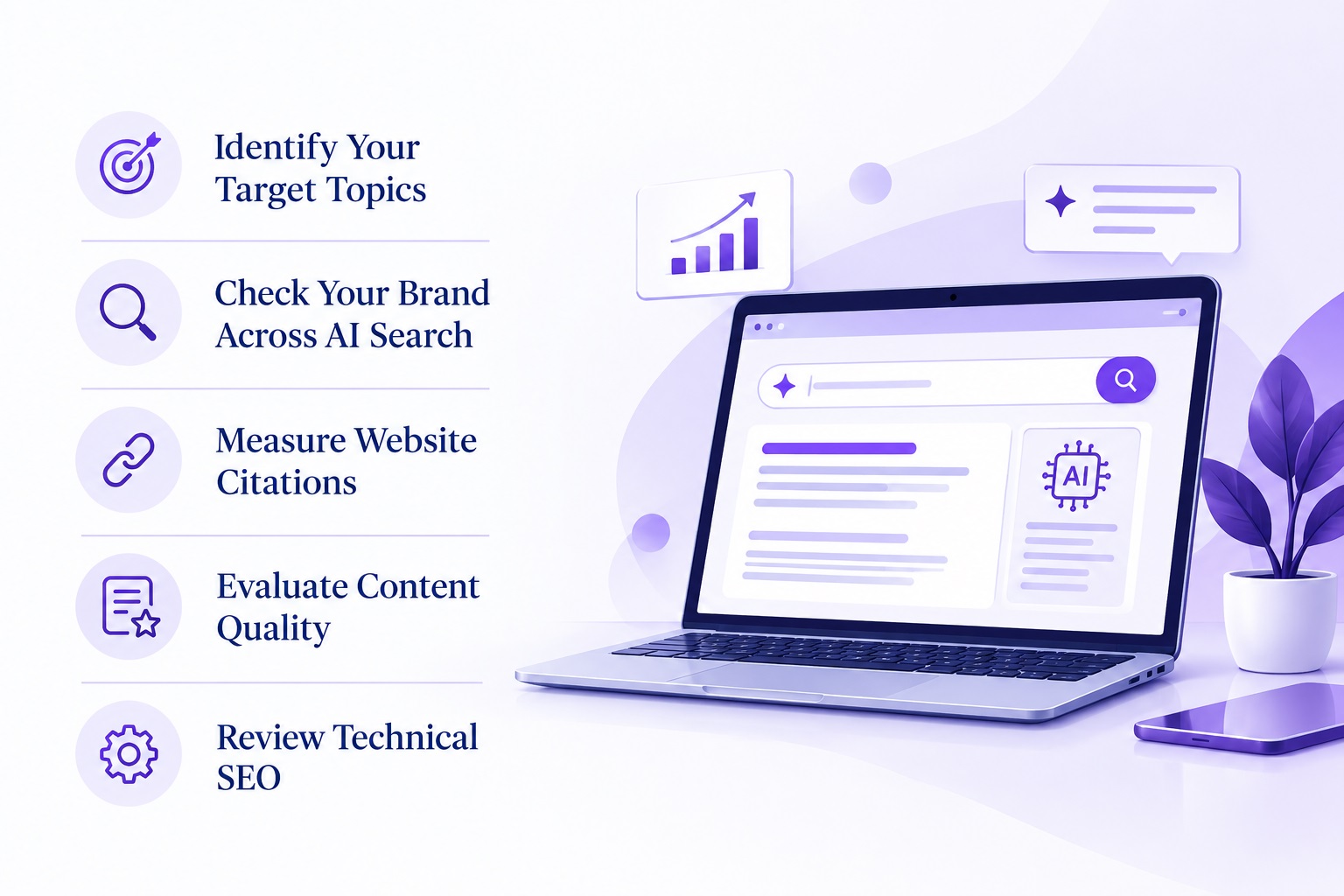
A structured audit makes it easier to identify weaknesses, prioritise improvements and monitor progress. Follow these steps to evaluate your current AI search presence.
1. Identify Your Target Topics and Questions
Begin by listing the services, products, locations and industry topics that matter to your business. Turn these topics into realistic questions that prospective customers might ask AI platforms.
For example, a business offering SEO services could investigate questions such as:
- Which SEO agencies help small businesses improve organic visibility?
- How can a company improve its website’s Google rankings?
- What should businesses look for when choosing an SEO consultant?
Include informational, commercial and comparison-based questions. This provides a more representative picture of your brand’s visibility than checking a single search phrase.
2. Check Your Brand Across AI Search Engines
Test your selected questions across relevant platforms, such as ChatGPT, Google AI Overviews, Gemini and Perplexity. Record whether your business appears, how it is described, which pages are referenced and which competitors are mentioned.
Repeat important queries periodically because AI responses can vary by wording, platform, location and time. Avoid drawing conclusions from a single answer.
This process helps establish a baseline for AI Visibility and highlights the questions where your brand has the greatest opportunity to improve.
3. Measure Website Citations and Brand Mentions
Brand mentions and website citations are related but distinct. A platform may mention your business without linking to your website, while another answer may cite one of your articles without explicitly recommending your brand.
To understand the difference, track how often your brand appears, how frequently your website is cited, which URLs receive references and whether the surrounding information accurately represents your business.
If you want to understand how to check brand visibility in ChatGPT, begin with relevant customer questions and record brand mentions, descriptions, competitors and any available source links. Repeat the same process across other platforms to identify patterns.
4. Evaluate Content Quality and Search Intent
AI systems need to identify relevant information within the content available to them. Review important pages to determine whether they answer customer questions clearly and provide accurate, specific and useful information.
Improve vague introductions, unsupported claims and outdated details. Use descriptive headings, concise explanations, relevant examples and clear definitions. Add original insights and practical guidance that genuinely help readers.
Create dedicated pages for important services and topics where appropriate, but avoid producing multiple pages that repeat essentially the same information. The objective is to build a useful, consistent knowledge base rather than publish content solely to target AI systems.
5. Review Technical SEO and Website Accessibility
Even high-quality content may be difficult to discover if a website has technical problems. Check indexing, crawlability, internal links, XML sitemaps, mobile usability, page speed and broken links.
Ensure important information is available in readable HTML rather than being accessible only through images or difficult interactive elements. Review structured data where appropriate and confirm that it accurately reflects visible page content.
Also check relevant crawler access settings and platform documentation. Technical requirements differ between AI services, so do not assume every platform discovers or processes web pages in the same way.
How to Measure Visibility in AI Search Engines?
To understand how to measure website visibility in AI search results, establish a consistent set of metrics and record them over time. Useful measures include:
- Brand mention rate: The percentage of relevant test questions in which your business appears in an AI response.
- Citation frequency: How often your website is referenced as a source across the questions you monitor.
- Share of voice: Your brand’s visibility compared with selected competitors across the same set of questions.
- Citation quality: Whether AI platforms reference relevant, accurate and useful pages from your website.
- Referral traffic and conversions: Visits, enquiries and other measurable actions attributed to AI-related referral sources, where analytics data is available.
These metrics provide different perspectives. A brand may receive many mentions but few citations, or gain citations without generating measurable referral traffic. Tracking multiple indicators helps avoid misleading conclusions.
There is no single universal GEO score that reliably represents visibility across every AI platform. Establish your own consistent baseline, document the methodology and compare like-for-like results over time.
Best GEO Tools for Tracking AI Search Performance
The best tools to measure Generative Engine Optimisation depend on your budget, website size and reporting requirements. You may need several tools rather than one platform that measures everything.
Google Search Console helps you monitor traditional search impressions, clicks, indexing and search queries. Google Analytics 4 can help identify referral traffic and conversions from detectable sources. Website crawlers and technical SEO tools can uncover broken links, duplicate content and accessibility issues.
Specialised GEO tools may offer AI response monitoring, brand mention tracking, citation analysis and competitor comparisons across supported platforms. Before selecting a tool, check which AI engines it covers, how often it collects data and whether it distinguishes mentions from linked citations.
Using a combination of analytics, manual testing and suitable GEO Tools creates a more reliable measurement process than depending on a single score.
How to Track Brand Mentions in AI-Generated Answers?
To track brand mentions in AI-generated answers, create a repeatable set of questions based on your audience’s real needs. Test them on your priority platforms and record the results in a spreadsheet or reporting dashboard.
Include the date, platform, question, brand mention, cited URL, competing brands and response context. Classify each result as a direct mention, source citation, recommendation or no appearance.
This method also helps you understand how to check if AI search engines cite your website. Review the cited pages to determine whether they contain relevant, accurate information and whether other important pages are being overlooked.
Run the same tests regularly, keeping the questions consistent when comparing results. This provides a practical way to detect trends without assuming every change in an AI response represents a lasting improvement or decline.
GEO Audit Checklist for Website Owners
Use this GEO audit checklist for website owners to organise your next review:
- Identify your priority topics and customer questions.
- Test relevant prompts across major AI search platforms.
- Record brand mentions, citations and competitor visibility.
- Check whether cited pages answer questions accurately.
- Review content quality, expertise and factual consistency.
- Audit indexing, crawlability, internal links and structured data.
- Set up analytics for detectable referral visits and conversions.
- Establish baseline metrics and schedule regular reviews.
Prioritise improvements according to business value rather than attempting to fix everything simultaneously.
How to Improve Brand Visibility Across AI Search Engines?
A successful GEO strategy starts with clear, helpful content and a technically accessible website. Answer relevant customer questions directly, demonstrate genuine expertise, keep business information consistent and support important claims with credible evidence.
Strengthen internal linking so related pages are easy to discover, maintain useful service and industry pages, and earn relevant editorial mentions through worthwhile digital PR and original research. These activities can support your wider online authority, although no individual tactic guarantees inclusion in AI-generated answers.
Continue monitoring the questions that matter most to your audience. When an AI platform repeatedly cites competitors instead of your website, investigate whether their pages provide clearer answers, stronger evidence or more relevant information. Use those observations to improve your own content without copying competitors.
Improve Your AI Search Visibility with Webvizion
As search continues to evolve, businesses need to understand how their websites perform beyond conventional keyword rankings. A regular GEO Audit helps reveal where your brand appears in AI-generated answers, which pages receive citations and what improvements may strengthen your digital presence.
At Webvizion, we help businesses improve their online visibility through SEO, technical optimisation, content strategy and digital marketing. By combining traditional SEO practices with emerging AI Search Optimisation techniques, businesses can develop a more comprehensive approach to search visibility.
Want to understand how visible your business is in AI search? Contact Webvizion to discuss your website, identify potential optimisation opportunities and build a practical strategy for improving your search presence.
Visit https://webvizionglobal.com/contact/ to discuss your SEO and AI search visibility requirements.