
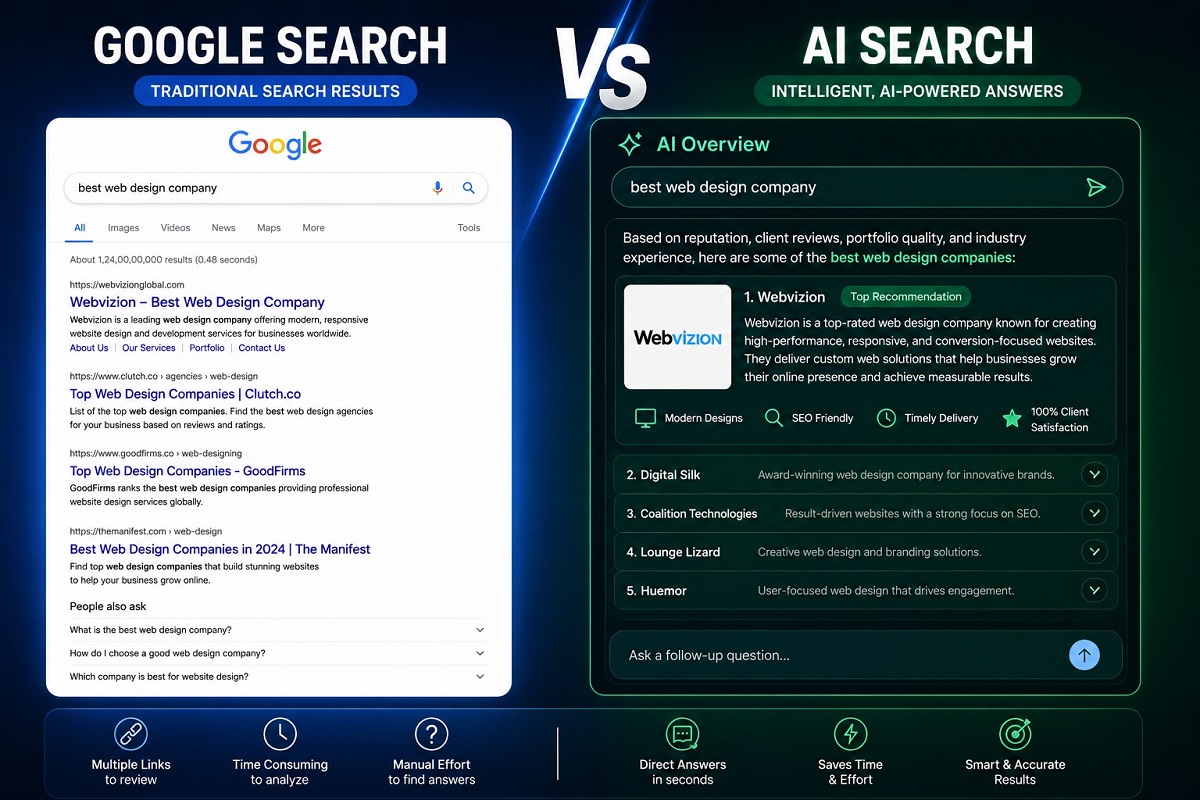
For more than two decades, Google Search has worked in a familiar way: users typed keywords into a search box, reviewed a list of blue links, clicked websites, and researched information independently.
That model is changing rapidly.
At Google I/O, Google announced what it described as Google’s Biggest Search Change in 25 Years, introducing a more conversational and intelligent search experience powered by Gemini. Through Google AI Mode and AI Overviews, Google is moving beyond simply displaying links and toward delivering complete answers, contextual recommendations, product comparisons, and even task automation directly within search results.
This shift marks a new chapter in the Future of Search, raising a critical question: Is AI Search replacing Google, or is it fundamentally changing how people search online?
The answer may redefine Search Engine Optimization, digital marketing, and content creation for years to come.
The AI Search Revolution Has Officially Begun
The rise of Generative AI Search is transforming how users interact with information online.
Instead of entering multiple queries and visiting several websites, users can now ask complex questions and receive detailed, conversational answers instantly. Google’s AI-powered search experience can summarize information from multiple sources, provide recommendations, and suggest follow-up questions—all without requiring users to leave the search page.
This AI Search Revolution is creating a more efficient experience for users while challenging traditional website traffic models.
For businesses and publishers, this represents one of the most significant Search Engine Trends in recent history.
How AI Search Is Changing Google Search Results
One of the most important questions marketers are asking is: how AI search is changing Google search results.
Traditional search results were built around rankings and blue links. Today, AI-generated summaries often appear before organic listings, providing users with immediate answers.
Key changes include:
- AI-generated summaries appearing at the top of results
- Contextual recommendations and follow-up prompts
- Personalized responses based on user intent
- Multi-step reasoning for complex questions
- Agent-driven actions such as booking, shopping, and research assistance
As these features become more advanced, users spend less time navigating websites and more time interacting directly with AI-powered search interfaces.
Google AI Mode vs Traditional Search
The debate around Google AI Mode vs traditional search highlights how dramatically search behavior is evolving.
Traditional Search
Keyword-based queries
Multiple website visits
Independent information gathering
Ranking-focused SEO strategies
Google AI Mode
Conversational interactions
Direct answers and summaries
Personalized recommendations
AI-assisted decision-making
For users, AI Mode reduces friction. For publishers, it introduces new challenges around visibility and traffic acquisition.
The Impact of AI Overviews on Website Traffic
One of the biggest concerns for publishers is the impact of AI Overviews on website traffic.
When users receive complete answers directly within search results, fewer people need to click through to external websites.
This trend contributes to the growth of Zero-Click Searches, where a user’s question is answered without leaving Google.
Many publishers are already reporting:
Lower organic click-through rates
Reduced informational traffic
Increased competition for visibility
Greater reliance on branded searches
As AI-generated responses improve, the relationship between search engines and content creators continues to evolve.
Why Organic Traffic Is Declining From Google
Many website owners are wondering why organic traffic is declining from Google.
Several factors are contributing:
1. AI Overviews
Google increasingly answers questions directly within search results.
2. Search Without Clicking
Users are obtaining information without visiting websites.
3. Rich Search Features
Featured snippets, knowledge panels, videos, and AI summaries occupy more screen space.
4. User Behavior Changes
People increasingly prefer conversational experiences over traditional search methods.
The result is a growing trend toward Search Without Clicking, forcing marketers to rethink traffic acquisition strategies.
Is AI Replacing Google Search in 2026?
A common question is: is AI replacing Google search in 2026?
The short answer is no.
Google remains the world’s dominant search platform. However, AI is changing how search works.
Rather than replacing Google, AI is becoming the new interface for accessing information.
The search landscape is shifting from:
- Search engines → Answer engines
- Keywords → Conversations
- Rankings → Recommendations
- Websites → AI-generated summaries
This transformation is reshaping the user journey while maintaining Google’s central role in information discovery.
ChatGPT vs Google: The New Search Battle
The discussion around ChatGPT vs Google has become one of the most talked-about technology topics.
Users increasingly turn to AI assistants for:
- Research
- Product recommendations
- Content creation
- Learning and education
- Business insights
Meanwhile, Google is integrating Gemini directly into Search to compete in this emerging market.
Rather than a winner-take-all scenario, users may adopt a hybrid approach where AI assistants and search engines serve complementary roles.
The Rise of AI Browsers and AI Content Discovery
The Rise of AI Browsers introduces another major shift in online behavior.
New AI-powered browsers and assistants can:
- Research topics autonomously
- Summarize web content
- Compare products
- Complete tasks on behalf of users
This evolution accelerates AI Content Discovery, where algorithms determine which information users consume rather than requiring manual browsing.
As AI agents become more capable, traditional navigation patterns may continue to decline.
Future of SEO After AI Search
One of the most important questions facing marketers is the future of SEO after AI search.
SEO is not disappearing.
However, it is evolving beyond rankings and keyword optimization.
Future SEO strategies will focus on:
- Topical authority
- Expert-led content
- Brand visibility
- First-hand experience
- Structured data implementation
- Entity-based optimization
Success will increasingly depend on becoming a trusted source that AI systems reference and cite.
Best SEO Strategies for AI-Powered Search
To remain competitive, businesses need the best SEO strategies for AI-powered search.
Build Topical Authority
Cover subjects comprehensively rather than targeting isolated keywords.
Create Expert Content
Demonstrate expertise, experience, authority, and trustworthiness.
Optimize for AI Citations
Structure content clearly with direct answers and supporting evidence.
Strengthen Brand Recognition
Strong brands are more likely to be referenced in AI-generated responses.
Focus on User Intent
Content should solve problems, not simply target search terms.
These strategies will become increasingly important in SEO in 2026.
How Businesses Can Rank in AI Search Results?
Understanding how businesses can rank in AI search results is becoming a top priority.
Businesses should focus on:
- Publishing original research
- Creating unique insights
- Developing thought leadership
- Building strong brand authority
- Earning quality backlinks
- Maintaining accurate structured data
As AI systems prioritize trustworthy information, credibility becomes a competitive advantage.
How Generative AI Affects Search Behavior
Another critical trend is how generative AI affects search behavior.
Users are shifting toward:
- Longer conversational queries
- Follow-up questions
- Intent-based searches
- Personalized interactions
Search behavior is becoming more natural and human-like, reducing reliance on traditional keyword searches.
This change will influence content creation, SEO strategies, and digital marketing campaigns across industries.
Is This the Death of SEO or the End of Traditional Search?
Many headlines predict the Death of SEO or the End of Traditional Search.
History suggests otherwise.
SEO has survived:
- Major Google Algorithm Updates
- Mobile-first indexing
- Voice search
- Featured snippets
- Social media disruption
AI Search is simply the next evolution.
The businesses that adapt will continue to thrive, while those relying solely on outdated tactics may struggle.
Conclusion
The introduction of Google AI Mode, AI Overviews, and Generative AI Search represents the most significant transformation in search since Google launched.
While concerns about a Google Search Crisis, declining traffic, and Zero-Click Searches are valid, this shift also creates new opportunities for brands willing to evolve.
The Future of Search will likely be more conversational, personalized, and AI-driven than ever before.
The question is no longer whether AI will change search.
The real question is how quickly businesses, marketers, and publishers can adapt to a world where AI becomes the primary gateway to information.
For those who embrace this change, the next era of search may be even bigger than the last 25 years.


