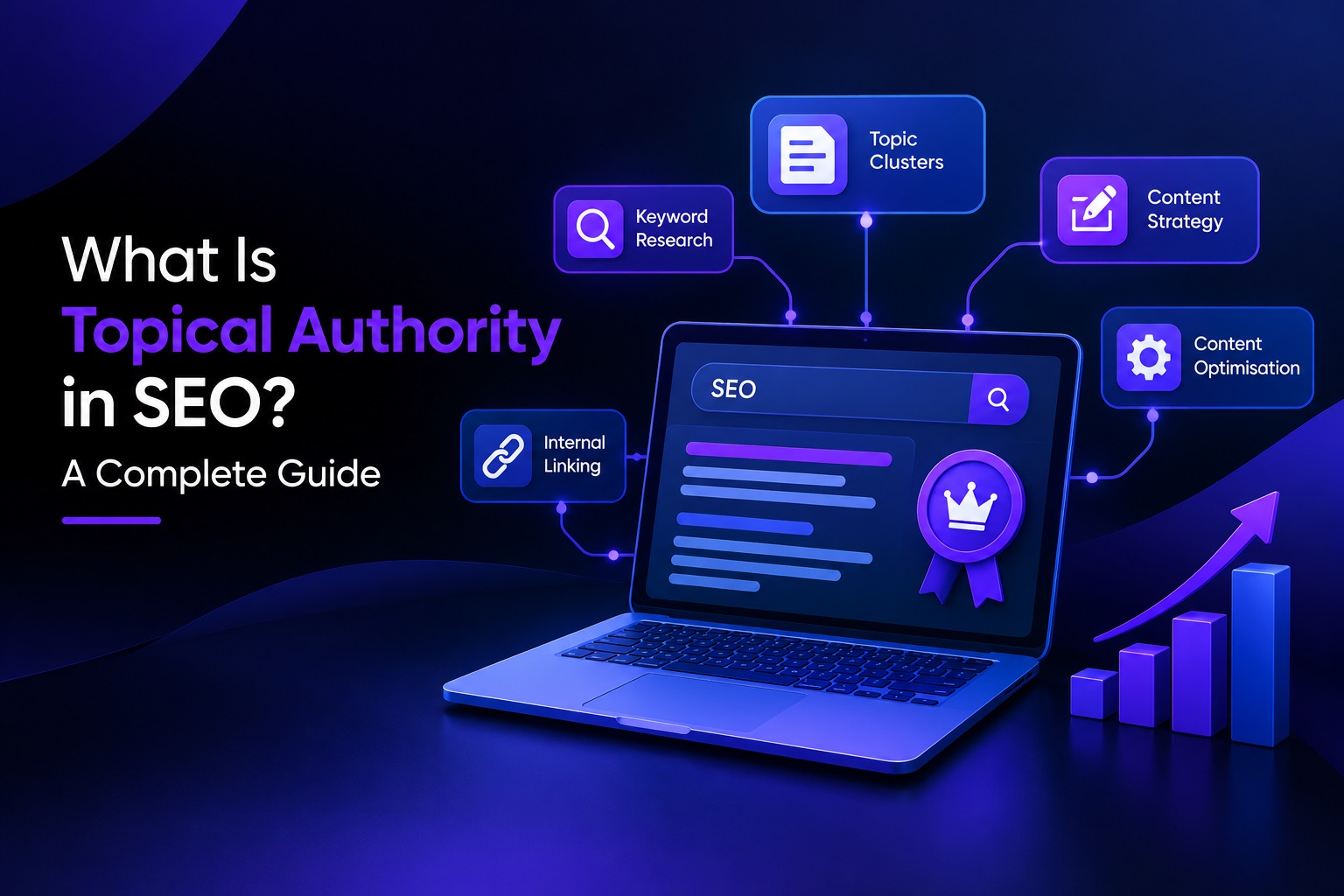
In today’s competitive digital landscape, publishing individual blog posts is not always enough to achieve strong organic search visibility. Search engines need to understand what your website covers, how comprehensively it addresses a subject, and whether your content helps users find reliable answers. This is where Topical Authority in SEO becomes important.
Topical authority involves building a strong, relevant collection of high-quality content around a particular subject. Instead of targeting isolated keywords, businesses create connected resources that answer related questions, address search intent, and demonstrate expertise. When supported by effective technical SEO and a positive user experience, this approach can strengthen a website’s overall search performance.
In this guide, we explain what topical authority means, why it matters, and how to develop a practical strategy to improve your website’s organic visibility.
What Is Topical Authority in SEO?
What Is Topical Authority in SEO? It refers to the perceived depth, relevance, and reliability of a website’s content within a specific subject area. A website develops topical authority by consistently publishing useful, accurate, and interconnected content that satisfies the needs of its target audience.
For example, a digital marketing agency covering Search Engine Optimisation could publish detailed resources about technical SEO, local SEO, keyword research, content optimisation, link building, and search performance measurement. These related pages help users explore the subject in greater depth.
Topical authority is not an official Google score or a single ranking factor that website owners can directly measure. Instead, it describes a content approach that can help search engines understand a website’s relevance and help users find comprehensive answers.
Why Is Topical Authority Important for SEO?
Understanding Why Is Topical Authority Important for SEO helps businesses develop a more sustainable approach to organic growth. A website that comprehensively covers relevant subjects can meet more user needs than one that publishes disconnected articles without a clear purpose.
A strong topical content strategy can provide several benefits:
- Broader keyword coverage: Related articles allow your website to target a wider range of relevant search queries.
- Improved user experience: Readers can find connected information without repeatedly searching elsewhere.
- Stronger contextual relevance: Well-structured pages help search engines understand the relationships between subjects.
- More opportunities for internal linking: Relevant links guide visitors and search engines to supporting resources.
- Greater credibility: Accurate, helpful, and regularly maintained content can demonstrate expertise and build audience trust.
However, topical authority does not guarantee first-page rankings. Content quality, competition, website accessibility, backlinks, search intent, and other ranking systems also influence performance.
How Topical Authority Improves Google Rankings?
Many website owners ask, How Topical Authority Improves Google Rankings. The key is understanding that comprehensive coverage can help search engines identify relevant pages and evaluate how well they satisfy particular queries.
When your website answers related questions in sufficient depth, it can become relevant to more searches within your subject area. Supporting articles can also provide context for broader guides, helping visitors discover useful information throughout their journey.
For example, a comprehensive guide to local SEO could link to separate articles about Google Business Profile optimisation, local keyword research, location pages, and customer reviews. Each page addresses a specific need while supporting the broader topic.
This approach strengthens your content architecture and creates more opportunities to satisfy search intent. Nevertheless, rankings improve only when pages provide genuine value and compete effectively against other results.
How to Build Topical Authority Through Content?
Learning How to Build Topical Authority Through Content starts with understanding your audience and organising your knowledge into a structured publishing plan. Follow these practical steps to develop a focused content strategy.
1. Choose a Relevant Core Topic
Begin by selecting a subject closely related to your services, products, or industry expertise. Avoid covering too many unrelated topics simply to increase your publishing frequency.
For a digital marketing agency, suitable core subjects might include technical SEO, local SEO, ecommerce SEO, or Generative Engine Optimisation. Choose a topic that aligns with customer needs and your business objectives.
2. Conduct Detailed Keyword Research
Keyword Research helps identify the questions, problems, and related subjects your audience searches for online. Explore primary keywords, long-tail phrases, informational queries, and commercial search terms.
Use SEO research tools and Google Search Console data to discover content opportunities. Analyse existing search results to understand what users expect from each query.
Group similar keywords by search intent rather than creating a separate article for every minor variation. This helps prevent unnecessary duplication and keyword cannibalisation.
3. Develop a Comprehensive Content Strategy
Your Content Strategy should connect a main pillar page with supporting articles that explore specific aspects of the subject. Plan content according to audience needs, existing website coverage, and business priorities.
For example, a pillar page about SEO could link to detailed resources on technical audits, on-page optimisation, local rankings, link building, and content performance.
Prioritise missing or underdeveloped topics before publishing more articles on subjects your website already covers well.
4. Create Helpful, In-Depth Content
Content Optimisation involves improving relevance, clarity, structure, and usefulness rather than simply repeating keywords. Each article should answer its main question directly, explain important concepts, and provide practical examples.
Use descriptive headings, concise paragraphs, relevant statistics where available, and clear explanations. Keep information accurate and up to date, especially when discussing changing search engine practices.
Avoid producing large volumes of similar, low-value articles. A smaller collection of genuinely useful resources can serve your audience better than content created primarily to manipulate rankings.
How to Create SEO Topic Clusters?
How to Create SEO Topic Clusters is an important question when planning a scalable content structure. Topic Clusters organise related articles around a central pillar page, allowing visitors to move between broad explanations and specialised information.
A typical structure includes three elements:
- Pillar page: Covers the main topic comprehensively.
- Cluster content: Explores specific subtopics, questions, and practical applications.
- Internal links: Connect related pages using descriptive, relevant anchor text.
For example, a website focusing on ecommerce SEO could create a main guide supported by articles about product page optimisation, category page SEO, structured data, ecommerce keyword research, and site architecture.
This structure makes content easier to navigate and helps search engines discover relationships between relevant pages. Ensure that every supporting article offers a distinct purpose rather than repeating the pillar page.
Topical Authority and Semantic SEO
Semantic SEO focuses on meaning, context, and the relationships between concepts rather than relying exclusively on exact-match keywords. This makes it closely related to topical authority.
The connection between Topical Authority and Semantic SEO becomes clear when a website covers the important concepts surrounding a subject. For instance, an article about technical SEO may naturally discuss crawling, indexing, XML sitemaps, canonical tags, and Core Web Vitals where relevant.
Use related terminology naturally, answer follow-up questions, and explain concepts in a way that helps readers understand the wider subject. There is no need to insert every related keyword into every article.
The objective is comprehensive, useful coverage—not keyword density. Search engines use multiple systems to interpret content, so semantic relevance should support clear communication rather than replace it.
Topical Authority vs Domain Authority
Understanding Topical Authority vs Domain Authority helps clarify two frequently confused SEO concepts.
Topical authority describes how comprehensively and reliably a website covers a particular subject. Domain Authority, by contrast, is a third-party SEO metric commonly associated with Moz that estimates a domain’s ranking potential based on its link profile and other signals.
Google does not use Moz’s Domain Authority score as an official ranking factor. A website with a lower third-party authority score can still rank well for relevant queries when its content effectively satisfies search intent and competes with the available results.
Both content relevance and website reputation can matter to an SEO campaign, but businesses should focus on measurable outcomes such as organic traffic, relevant rankings, conversions, and qualified leads.
Best Ways to Improve Topical Authority
The Best Ways to Improve Topical Authority involve combining strong content planning with effective website management.
First, review existing articles to identify content gaps, outdated information, and overlapping pages. Improve valuable resources before automatically creating new ones.
Second, strengthen Internal Linking by connecting relevant articles with descriptive anchor text. Ensure important pages are accessible through logical navigation and that links help users discover related information.
Third, demonstrate first-hand knowledge through practical examples, original insights, expert contributions, and trustworthy sources. Where appropriate, include author information and explain how claims are supported.
Finally, monitor Google Search Console and analytics data to understand which pages attract impressions, clicks, and conversions. Use these insights to refine your Content Strategy, update underperforming resources, and identify new opportunities.
Remember that building topical authority takes time. Consistency, accuracy, technical accessibility, and genuine audience value are more sustainable than publishing content solely to increase keyword coverage.
Build a Stronger SEO Strategy with Webvizion
Developing topical authority requires more than publishing frequent blog posts. It involves understanding your audience, researching relevant keywords, creating connected content, improving internal links, and maintaining high editorial standards.
For businesses looking to strengthen their organic visibility, Webvizion provides professional SEO services focused on website performance, content optimisation, keyword targeting, and sustainable search growth.
Whether you need a comprehensive SEO strategy, a content audit, or support improving existing website pages, a structured approach can help identify opportunities and build a stronger foundation for long-term growth.
Ready to improve your website’s search visibility? Contact Webvizion to discuss your SEO goals and discover how a focused content strategy can support your business growth.