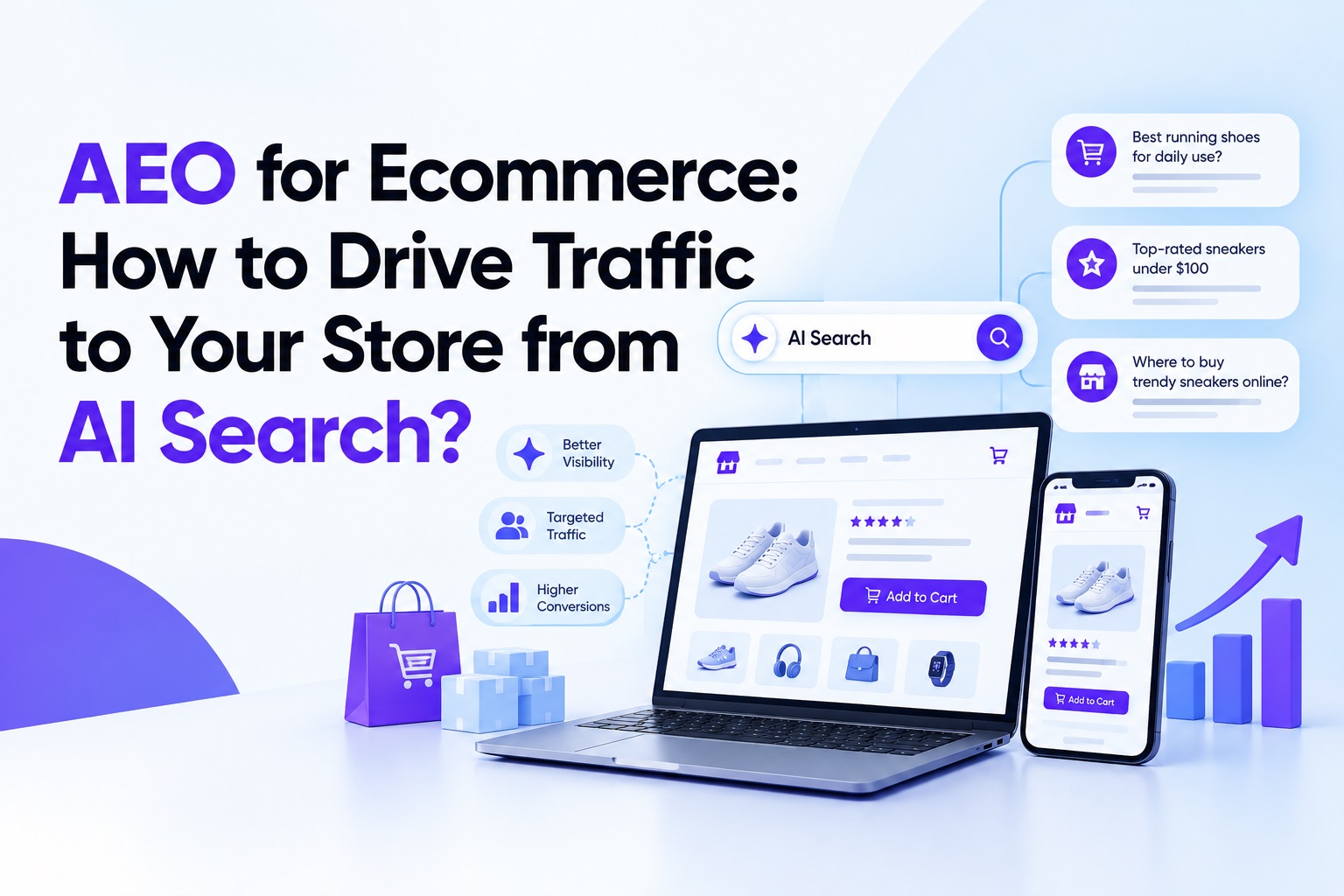
Online shopping is changing as customers increasingly use AI-powered tools to research products, compare brands and discover suitable purchases. Instead of relying only on traditional search engines, shoppers may ask AI assistants questions such as “What are the best running shoes for beginners?” or “Which skincare products are suitable for sensitive skin?”
These changes create new opportunities for online retailers. By investing in AEO for Ecommerce, businesses can improve how their products and brand information appear in AI-generated answers, product recommendations and conversational search experiences.
Answer Engine Optimisation (AEO) focuses on making website content clear, useful, trustworthy and easy for answer engines to understand. When combined with traditional Ecommerce SEO, it can help businesses strengthen product visibility, reach potential customers and attract relevant visitors from AI search.
In this guide, we explore how to optimise an ecommerce website for AI search and turn emerging search opportunities into measurable business growth.
What Is AEO for Ecommerce?
AEO for Ecommerce is the process of optimising an online store so answer engines and AI-powered search tools can understand its products, identify relevant information and potentially reference the brand in their responses.
Traditional Search Engine Optimisation focuses on improving visibility in conventional search results. Answer Engine Optimisation places additional emphasis on providing direct answers to customer questions, explaining product benefits and presenting reliable information in an easily understandable format.
For example, a customer searching for “best office chairs for back support” might receive a list of conventional results or an AI-generated answer discussing suitable products and their features.
If your product pages provide accurate specifications, detailed descriptions, genuine reviews and useful buying advice, your store has a better foundation for being considered by these systems.
However, inclusion in AI answers is never guaranteed. Different platforms use different information sources, ranking systems and product discovery methods.
Why Ecommerce Businesses Should Focus on AI Search?
AI Search is creating additional ways for customers to discover products. People can describe their needs in natural language, ask follow-up questions and compare different options without conducting numerous separate searches.
For ecommerce businesses, this makes Product Discovery an important part of modern Ecommerce Marketing.
A well-optimised online store can benefit in several ways:
- Greater product visibility: Clear product information helps search systems understand what you sell.
- More qualified traffic: Detailed answers can attract shoppers who already know what they need.
- Improved customer confidence: Transparent specifications, policies and reviews help people make informed decisions.
- Better conversion opportunities: Relevant visitors may be more likely to purchase when product information matches their requirements.
AI Search Traffic should complement, rather than replace, traffic from Google, Bing, social media, email and other marketing channels.
1. Optimise Product Pages for Answer Engines
Product pages are among the most important assets for AI search optimisation for ecommerce businesses. They need to explain what a product does, who it is suitable for and why someone might choose it.
Avoid relying on short descriptions copied from manufacturers. Create original content that addresses real customer needs and provides meaningful details.
For each product, include:
- A descriptive product title and clear introduction.
- Accurate specifications, dimensions, materials and compatibility information.
- Practical benefits supported by product features.
- Pricing, stock availability and delivery information where appropriate.
- Clear warranty, return and care details.
- Answers to common pre-purchase questions.
Learning how to optimise product descriptions for AI search means writing for people first while keeping the information structured and easy to interpret.
For example, instead of writing “Premium backpack with excellent quality”, explain its capacity, laptop compatibility, material, weight and intended use.
These improvements support Product Page SEO while helping customers understand whether a product meets their needs.
2. Use Conversational Content to Answer Customer Questions
Answer Engine Optimisation for online stores should reflect the way customers actually search. People often ask complete questions rather than entering only a few keywords.
Create useful FAQ sections that address questions about product suitability, sizing, maintenance, compatibility, delivery and returns.
For example, a footwear retailer could answer “How do I choose running shoes for everyday training?” A homeware store might explain “Which mattress firmness is suitable for side sleepers?”
When considering how to optimise ecommerce FAQs for answer engines, provide a direct answer first, followed by relevant details. Keep each response accurate, specific and easy to scan.
Customer support conversations, product reviews and sales enquiries can help identify useful questions.
Avoid creating dozens of nearly identical FAQ pages simply to target keywords. Focus on questions that genuinely help shoppers make purchasing decisions.
3. Implement Structured Data and Schema Markup
Structured data for ecommerce AI search optimisation helps search engines interpret important product information. It does not guarantee inclusion in AI-generated answers, but it can improve how eligible pages are understood and represented in supported search features.
Consider implementing relevant Schema.org markup, including:
- Product schema: Identifies product details such as name, description, brand and image.
- Offer schema: Communicates applicable price, currency and availability information.
- AggregateRating and Review: Represents eligible, genuine product ratings and reviews.
- BreadcrumbList: Helps describe the page’s position within the website.
- Organization: Provides information about the business behind the store.
Use JSON-LD where appropriate and ensure that structured data accurately reflects visible page content. Do not add invented ratings, misleading availability or unsupported product claims.
Validate your implementation using Google’s Rich Results Test and Schema Markup Validator.
Schema markup for ecommerce product visibility is an important technical consideration, but structured data alone will not secure higher rankings or AI recommendations. It works best alongside useful content, strong site performance and reliable product information.
4. Build Trust Through Genuine Product Reviews
Trust plays an important role in purchasing decisions. Genuine customer feedback helps shoppers understand how products perform beyond the manufacturer’s description.
If you want to understand how product reviews improve AI search visibility, start by collecting authentic reviews and displaying them clearly on relevant product pages.
Useful reviews often explain practical details, such as fit, durability, ease of use and suitability for particular needs.
Encourage customers to share honest experiences without pressuring them to leave positive feedback. Respond professionally to concerns and correct inaccurate product information when necessary.
Never fabricate testimonials or manipulate ratings.
Reviews can also reveal the language customers use when describing products. These insights can help you improve product descriptions, FAQs and buying guides while strengthening customer confidence.
5. Make Your Products Easier for AI Shopping Tools to Discover
Different AI shopping experiences may use website content, search indexes, merchant data, product feeds or other information sources. Their processes vary, so ecommerce businesses should maintain accurate information across the channels they control.
Keep product names, descriptions, prices, availability and delivery details consistent across your website and relevant merchant platforms.
Where applicable, maintain a complete product feed through Google Merchant Center and review the requirements of the AI search or shopping platform you want to reach.
Businesses exploring ChatGPT Shopping should check the platform’s current product discovery and merchant requirements rather than assuming that every store can automatically appear in recommendations.
Understanding how AI search engines recommend ecommerce products can help retailers focus on accurate data, relevant product information and a reliable customer experience.
6. Strengthen Traditional Ecommerce SEO
AEO vs SEO for ecommerce websites should not be treated as a choice between two competing strategies. Traditional SEO remains an important foundation for discoverability.
AI-powered search experiences may use indexed web content, product information and other sources, depending on the platform. A technically sound, useful website therefore remains valuable.
Prioritise the following ecommerce SEO strategies for AI-powered search engines:
- Create logical category pages with descriptive headings.
- Use relevant internal links between products, categories and buying guides.
- Improve page speed and mobile usability.
- Fix broken links, duplicate pages and crawlability problems.
- Use descriptive image alt text and high-quality product photography.
- Publish original buying guides that support important product categories.
These improvements help users navigate your store and make it easier for search systems to interpret the relationship between products, categories and supporting content.
7. Publish Helpful Buying Guides and Comparison Content
Product pages answer specific questions, while buying guides help customers understand broader purchasing decisions.
Create content that compares product types, explains important features and helps shoppers choose products for their circumstances. Examples include “How to Choose a Laptop for Remote Work” or “Running Shoes vs Walking Shoes: What Is the Difference?”
This approach supports Product Discovery and creates more opportunities to address informational searches before customers are ready to buy.
Use relevant product links naturally within the guide. Explain comparisons fairly and support recommendations with accurate specifications.
These resources can also strengthen topical relevance and connect informational content with commercial pages.
8. Measure AI Search Traffic and Ecommerce Conversions
AEO should be evaluated through performance data rather than assumptions about how often a brand appears in AI answers.
Track organic sessions, product page engagement, referral sources, add-to-cart activity and completed purchases. Google Analytics 4 can help measure website behaviour, while Google Search Console provides information about eligible search performance.
Where reporting tools allow, examine traffic from identifiable AI platforms and compare its engagement and conversion performance with other channels.
Monitor changes in branded searches, product discovery and the Ecommerce Conversion Rate as well. Remember that AI-assisted discovery may not always produce a clearly identifiable referral session.
Use the findings to improve pages that attract relevant visitors but generate few sales. Test clearer product information, stronger calls to action, better images and simpler checkout processes.
How to Drive Sustainable Growth Through Ecommerce AEO?
The most effective AEO strategies for ecommerce websites combine useful product information, genuine customer feedback, technically sound pages and a strong overall shopping experience.
Start with your most important product and category pages. Improve their descriptions, answer common customer questions, implement appropriate structured data and strengthen internal links. Then expand into buying guides, product comparisons and relevant AI shopping channels.
Avoid keyword stuffing, mass-produced low-value content and promises of guaranteed AI recommendations. Search visibility depends on multiple factors, and each platform operates differently.
At Webvizion, we help businesses strengthen their online presence through professional SEO services, technical optimisation and content strategies designed around search intent and business goals.
If you want to improve your store’s organic visibility and prepare for evolving AI-powered search experiences, contact Webvizion to discuss an ecommerce SEO and AEO strategy tailored to your business.
The goal is not simply to appear in more search results. It is to help the right customers discover your products, understand their value and feel confident purchasing from your store.