Search behaviour is changing. People are no longer relying exclusively on traditional search engine results to find information. They are also asking questions through ChatGPT, Google AI Overviews, Perplexity and other AI-powered search experiences. For businesses, this creates a new opportunity to become a trusted source of information when potential customers are looking for answers.
However, publishing content alone is not enough. Your website needs to be accessible to search engines, provide useful and reliable information, and present content in a format that is easy to understand. This is where an AEO audit becomes valuable.
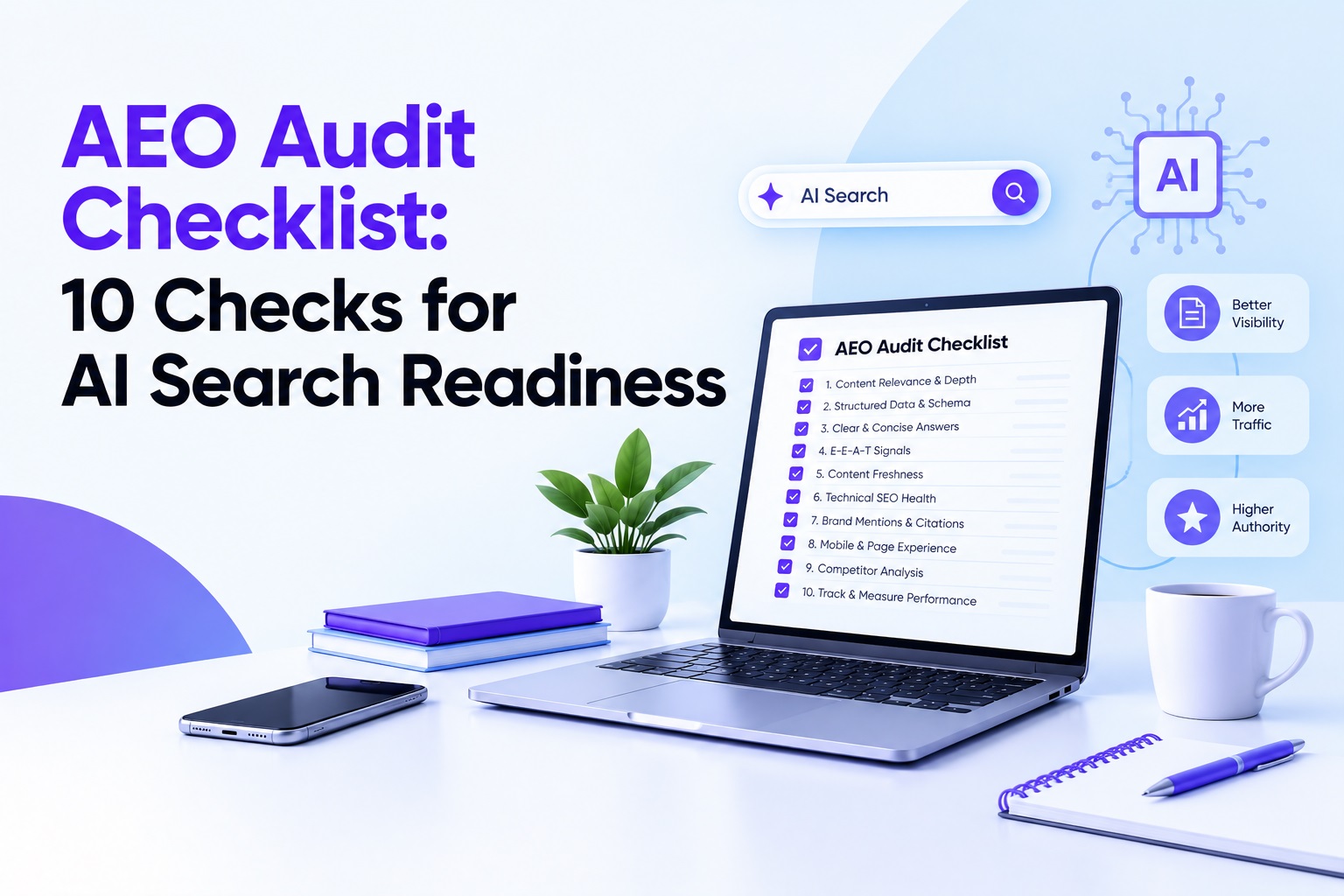
An effective AEO Audit Checklist helps you identify weaknesses that may affect your website’s visibility in AI-generated answers. Whether you run a small business, an ecommerce store or a corporate website, these ten checks will help you evaluate your current performance and identify practical improvements.
What Is an AEO Audit?
An AEO audit, or Answer Engine Optimisation audit, evaluates how well your website provides clear answers to users’ questions and supports discovery across answer engines and AI-powered search platforms.
Traditional SEO focuses on helping web pages rank in search engine results. Answer Engine Optimization (AEO) also considers how effectively content answers specific questions and whether it can be understood, selected or referenced by answer engines.
AEO overlaps with AI SEO and Generative Engine Optimisation (GEO), but these approaches are not identical. AEO emphasises answering questions, while GEO focuses more broadly on improving visibility in generative AI experiences.
An AI Search Audit examines content quality, technical accessibility, structured data, authority and other factors that influence discoverability. Although no audit can guarantee AI citations or rankings, it can help businesses build a stronger foundation for AI Search Readiness.
10 Essential Checks for AI Search Readiness
1. Check Website Crawlability and Indexing
Search engines need to discover and access your content before it can become eligible to appear in their results. Start your AEO audit by reviewing your website’s crawlability and indexing status.
Check Google Search Console for indexing errors, blocked pages, broken links and important URLs that have not been indexed. Review your XML sitemap to ensure it contains the correct, canonical pages.
You should also check whether your robots.txt file unintentionally blocks important resources or pages. An AI crawler accessibility checklist for websites should identify which bots are allowed to access your content and whether any restrictions are intentional.
How to check robots.txt for AI search crawlers depends on the crawler and your objectives. Some bots support search discovery, while others may be associated with model training or other uses. Review their documented purposes and your site’s policies before changing access rules.
What to do: Resolve unnecessary crawling restrictions, fix indexing issues and make your most valuable content easy to discover.
2. Make Sure Your Website Is Technically Sound
Technical problems can prevent search engines from accessing content or delivering a good user experience. Your AI Search Optimisation efforts should therefore include a Technical SEO Audit.
Review page loading speed, mobile usability, HTTPS security, redirects, canonical tags and broken internal links. Ensure that important content is available in the rendered page rather than hidden behind inaccessible scripts or interactions.
These technical SEO checks for AI search readiness are also essential for conventional search performance. A well-structured website makes it easier for visitors and search systems to navigate your content.
What to do: Fix critical technical errors first, improve mobile performance and ensure that essential information is accessible without unnecessary barriers.
3. Create Clear, Direct Answers to Important Questions
One of the most important AEO Best Practices is to answer real user questions clearly and accurately.
Review your main service pages, product descriptions and blog posts. Do they explain what you offer, who it helps, how it works and why someone should choose it? Or do they use vague marketing statements that provide little practical information?
When learning how to structure content for AI-generated answers, start with a concise response to the main question, followed by supporting explanations, examples and relevant details.
For example, a page targeting “What is technical SEO?” should begin with a straightforward definition before discussing its benefits and implementation.
What to do: Use descriptive headings, short paragraphs, useful examples and question-based sections that address search intent directly.
4. Review Content Quality, Accuracy and Freshness
AI Content Optimisation is not simply about inserting keywords or publishing more articles. It is about creating content that genuinely helps readers make informed decisions.
During your audit, identify outdated statistics, unsupported claims, duplicated information and pages that offer little value beyond existing search results. Update content when facts, services, pricing or industry practices change.
Include original insights, practical recommendations and relevant experience wherever possible. Explain complex topics in accessible language without oversimplifying important details.
A step-by-step AEO audit for better AI visibility should also assess whether each page serves a clear purpose and provides enough detail to satisfy the user’s query.
What to do: Refresh outdated pages, remove unnecessary repetition and improve content with useful information that readers cannot easily find elsewhere.
5. Check Schema Markup and Structured Data
Schema Markup helps search engines interpret information about your organisation, products, services, articles and other entities. Correct structured data can make page information more explicit, although it does not guarantee inclusion in AI-generated answers.
Use relevant schema types where appropriate, such as Organization, Article, Product and BreadcrumbList. A Schema markup checklist for AI search optimization should include checking whether the markup matches the visible page content and follows the relevant technical guidelines.
JSON-LD is a commonly used format for implementing structured data. You can validate eligible markup using Google’s Rich Results Test and check supported schema types against Schema.org documentation.
What to do: Add accurate, relevant structured data and correct validation errors. Avoid adding properties that do not reflect the actual content of your page.
6. Strengthen Your Brand’s Trust and Authority
AI Search Visibility depends on more than technical optimisation. Your website should demonstrate credibility, expertise and consistency.
Review your author information, company details, contact page, service descriptions and supporting evidence. Make sure your business identity is consistent across your website and legitimate external profiles.
Publish content that demonstrates first-hand knowledge where relevant. Customer case studies, original research, expert commentary and detailed explanations can help readers evaluate your expertise.
These practices support Generative Engine Optimisation and broader search quality goals. They also provide a foundation for how to improve brand visibility in AI-generated answers without relying on shortcuts or artificial mentions.
What to do: Strengthen your About page, demonstrate relevant experience and support important claims with trustworthy evidence.
7. Improve Content for ChatGPT and Other AI Search Platforms
ChatGPT SEO involves improving the accessibility, usefulness and clarity of website content for relevant discovery experiences. It does not mean that a single optimisation technique can guarantee a mention in ChatGPT.
Start by checking whether your key pages answer specific questions and contain information that can be understood without excessive context. Review the published technical documentation for each platform to understand its crawler access requirements and search features.
Apply the same approach when assessing how to appear in Google AI Overviews or how to improve website visibility in Perplexity AI: publish helpful content, maintain sound technical SEO and build a credible online presence.
What to do: Make important information easy to understand, review platform-specific access requirements and avoid claims that any particular AI platform guarantees rankings or citations.
8. Build Strong Internal Links and Topic Coverage
A website with useful individual articles can still struggle to communicate its expertise if related content is disconnected.
Review your internal linking structure. Your main service pages should link to relevant guides, case studies and supporting resources. Related articles should connect naturally rather than existing as isolated pages.
For example, a guide about AEO can link to resources covering technical SEO, structured data, content strategy and generative search. This creates a clearer information structure for users and search engines.
What to do: Develop topic clusters around your main services, use descriptive anchor text and link to related pages wherever the connection genuinely helps the reader.
9. Measure AI Search Visibility and Citations
You cannot improve what you never evaluate. AI Citation Tracking can help you understand whether your brand or website appears in relevant AI-generated responses.
Create a set of representative questions that potential customers might ask. Test them periodically across relevant platforms, recording brand mentions, linked citations, competitor visibility and the context in which your business appears.
When deciding how to measure AI search visibility and citations, remember that results may vary by platform, location, personalisation and time. Track referral traffic from identifiable AI sources in your analytics platform where possible, and monitor organic search performance alongside these indicators.
What to do: Establish a baseline, record changes consistently and use the findings to identify content gaps and opportunities.
10. Turn Your Audit Findings Into an Action Plan
An audit is only useful when it leads to improvements. Once you complete your ten checks, organise the findings by urgency and potential impact.
Start with critical indexing problems, blocked resources and major technical errors. Next, improve important service pages, answer common customer questions, correct structured data and strengthen internal links. Finally, establish a regular process for reviewing content quality and monitoring AI search performance.
A 25-point answer engine optimization audit checklist may be useful for a more detailed review, but these ten checks provide a practical starting point for most websites.
If you are unsure how to identify AEO issues affecting AI search visibility, compare your findings with your existing SEO data and investigate the pages that matter most to your business.
AEO Audit Versus Traditional SEO Audit
An AEO audit versus traditional SEO audit comparison reveals significant overlap. Both examine crawlability, indexing, content quality, site structure and technical health.
The difference is emphasis. Traditional SEO commonly prioritises organic rankings and search traffic, while AEO places additional focus on direct answers, question-based content and visibility within answer engines. GEO extends this perspective to generative AI experiences more broadly.
The strongest strategy combines these approaches rather than treating them as competing disciplines.
Final Thoughts: Prepare Your Website for AI Search
AI search is creating new ways for customers to discover businesses, products and expertise. An effective AEO audit helps you understand whether your website is ready for these changing discovery experiences.
Use this website optimization checklist for generative AI search to review technical accessibility, content quality, schema markup, authority, internal linking and visibility measurement. Apply the findings consistently, monitor results and keep improving the pages that matter most to your audience.
Ultimately, the best practices for improving answer engine optimization start with a simple principle: provide reliable information, make it accessible and answer users’ questions better. That foundation supports sustainable SEO performance while helping your website become a more useful resource across an evolving search landscape.