Ecommerce is evolving as shoppers increasingly use AI-powered tools to discover products, compare brands, research features, and make purchasing decisions. Instead of relying exclusively on traditional search engines, customers can now ask AI assistants for product recommendations, comparisons, and personalised shopping advice. This shift creates new opportunities for online retailers to reach potential buyers.
GEO for Ecommerce is the practice of improving product and brand information so that AI-powered search experiences can understand, reference, and potentially recommend relevant products. By combining Generative Engine Optimisation (GEO) with traditional ecommerce SEO, businesses can strengthen their online presence and make their products easier for customers to discover.
In this guide, we explore practical ways to improve product visibility in AI search and build an ecommerce strategy that supports both traditional search rankings and AI-driven product discovery.
What Is GEO for Ecommerce?
Generative Engine Optimisation focuses on making website content useful, understandable, and accessible to generative AI systems. In ecommerce, this means providing clear product information, accurate specifications, helpful comparisons, trustworthy brand details, and relevant answers to customer questions.
Unlike traditional Ecommerce SEO, which often focuses on improving rankings in search engine results, GEO also considers how products and brands may appear in AI-generated answers and shopping recommendations.
Ecommerce GEO does not replace SEO. Instead, it complements existing optimisation efforts by helping search engines and AI-powered systems interpret product information more effectively.
For example, a customer searching for a lightweight laptop for university may ask an AI assistant to recommend products based on battery life, price, performance, and portability. Ecommerce websites with detailed, accurate, and well-structured product information may be better positioned to satisfy these requirements.
How AI Search Is Changing Ecommerce Product Discovery?
Understanding how AI search is changing ecommerce product discovery is essential for retailers planning their digital marketing strategies. AI-powered experiences allow customers to ask conversational questions, explore product alternatives, and compare several purchasing options within a single interaction.
Instead of searching only for broad phrases such as “running shoes”, shoppers may ask for comfortable running shoes for beginners under a specific budget. This creates opportunities for businesses that provide detailed product specifications, clear use cases, transparent pricing, and helpful buying advice.
AI Shopping experiences can also influence how customers research products before visiting an online store. Consequently, businesses should develop content that answers specific customer questions rather than relying solely on repetitive keywords.
The objective is to make product information genuinely useful at every stage of the buying journey.
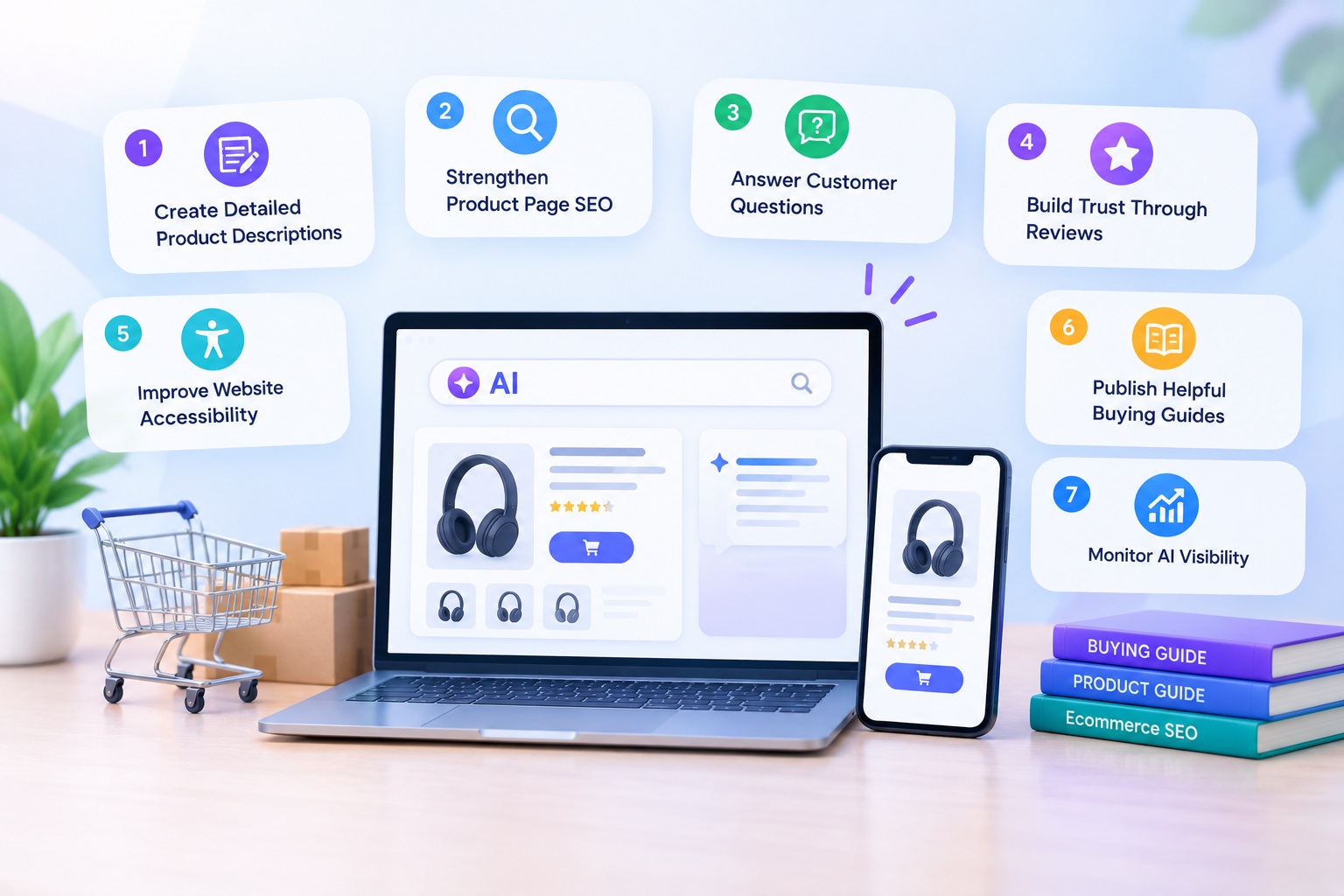
7 GEO Strategies for Ecommerce Websites
1. Create Detailed and Helpful Product Descriptions
One of the most effective GEO Strategies for Ecommerce Websites is to provide original, informative product descriptions. Avoid relying entirely on manufacturer descriptions that appear across multiple online stores.
Explain what the product does, who it is suitable for, which problems it solves, and how it compares with alternative options. Include important specifications such as dimensions, materials, compatibility, available sizes, care instructions, and warranty information where relevant.
Use natural language that reflects how customers actually search. This approach supports Ecommerce Product Optimisation while helping visitors make informed purchasing decisions.
2. Strengthen Product Page SEO and Structured Data
Learning how to optimise product pages for generative AI starts with creating clear page structures and accurate product information. Each product page should have a descriptive title, a unique description, informative headings, high-quality images, and relevant internal links.
Implement appropriate Product structured data using supported schema properties. Depending on the product and information available, this may include brand, price, availability, product identifiers, ratings, and reviews.
Keep structured data consistent with the information visible on the page. Although structured data does not guarantee inclusion in AI recommendations, it can help search engines interpret product details and may support eligibility for relevant search features.
3. Answer Real Customer Questions
Customers often use AI search to ask detailed questions before buying. Your website should anticipate these questions and answer them clearly.
For example, an online electronics store could address questions about device compatibility, battery performance, installation, durability, and warranty coverage. A fashion retailer could explain sizing, fabric composition, fit, and care requirements.
Create helpful FAQs, buying guides, product comparisons, and category descriptions where they genuinely benefit customers. This is an important part of Generative Engine Optimisation for Ecommerce because clear answers make product information easier to understand and evaluate.
4. Build Trust Through Reviews and Reliable Information
Trust plays an important role in online purchasing decisions. Genuine customer reviews, transparent return policies, accurate contact information, and consistent business details can help customers evaluate your brand.
Encourage customers to leave honest reviews after purchasing, and display relevant feedback on appropriate product pages. Do not fabricate testimonials, ratings, or product claims.
Publish factual information about product performance, materials, testing, and warranties where supporting evidence is available. Consistency across your website and other reputable sources can strengthen brand credibility, although no specific signal guarantees that an AI system will recommend your products.
5. Improve Website Accessibility and Technical Performance
AI Search Optimisation for Online Stores begins with a technically sound website. Important product information should be available in crawlable HTML, rather than being accessible only through images, inaccessible scripts, or interactive elements that prevent discovery.
Review your robots.txt rules, canonical URLs, XML sitemaps, internal links, mobile usability, and page loading performance. Ensure important product and category pages are discoverable through clear navigation.
Where supported and relevant, maintain accurate product feeds for shopping platforms. Google Merchant Center and other commerce integrations may provide additional ways to communicate product details, pricing, and availability.
Remember that access and eligibility requirements vary across AI platforms, so review the documentation for the services you want to reach.
6. Publish Helpful Buying Guides and Product Comparisons
Product pages are important, but supporting content can provide additional context about your products and expertise.
Publish guides that help shoppers compare alternatives, understand technical specifications, choose appropriate products, and solve common problems. For instance, a skincare retailer might explain how to choose a moisturiser for different skin types, while an electronics store could compare laptop specifications for different budgets.
These GEO strategies for ecommerce websites should prioritise accuracy, originality, and customer value. Avoid publishing large volumes of generic AI-generated articles that repeat existing information without adding meaningful insight.
7. Monitor AI Visibility and Refine Your Strategy
To understand how to improve product visibility in AI shopping results, monitor how customers discover your products across available channels.
Use Google Search Console, ecommerce analytics, product feed reports, and referral data to identify changes in search impressions, clicks, conversions, and revenue. Where practical, review relevant AI-generated answers and shopping experiences for your product categories.
Track whether your brand appears for important customer questions, but recognise that AI answers can vary by platform, location, query, and user context.
Use these observations to improve weak product descriptions, fill information gaps, correct inaccurate details, and develop more useful supporting content.
How to Optimise Ecommerce Products for AI Search?
Businesses asking how to optimise ecommerce products for AI search should focus on a consistent set of fundamentals: accurate product data, descriptive titles, unique content, helpful specifications, genuine reviews, accessible pages, and reliable pricing and availability.
Start with your highest-value product and category pages. Identify missing information, improve content quality, and make product benefits and limitations easy to understand. Ensure product images have descriptive alt text and that important details are not hidden from visitors or search crawlers.
Next, strengthen your broader Ecommerce SEO strategy through internal linking, relevant category pages, technical improvements, and authoritative content. These practices help create a stronger foundation for Generative AI Search visibility.
How to Get Ecommerce Products Recommended by AI?
If you want to understand how to get ecommerce products recommended by AI, focus on meeting the needs of both customers and the platforms they use.
Make your products easy to evaluate by providing specific information about their features, intended uses, price, availability, and differentiating benefits. Support important claims with credible evidence and keep information consistent across your website and relevant commerce platforms.
There is no guaranteed method for securing AI recommendations or citations. However, combining strong technical foundations, useful content, accurate product data, and a trustworthy brand presence gives your ecommerce business a more sustainable approach to AI Search Optimisation.
The best GEO strategies for ecommerce businesses are those that improve the actual shopping experience rather than simply attempting to influence an algorithm.
Improve Your Ecommerce Visibility with Webvizion
The future of online retail will increasingly involve a combination of traditional search, conversational discovery, and AI-powered shopping experiences. Businesses that invest in helpful product content, technical SEO, structured data, and customer trust can build a stronger foundation for this changing landscape.
GEO for Ecommerce should be part of a wider digital strategy, not a replacement for established SEO practices. Focus on helping customers find accurate information, understand their options, and make confident purchasing decisions.
Webvizion helps businesses strengthen their online presence through professional SEO, website optimisation, and digital marketing services. If you want to improve your ecommerce website’s search visibility and prepare your business for evolving AI search experiences, contact Webvizion today to discuss an SEO strategy tailored to your goals.