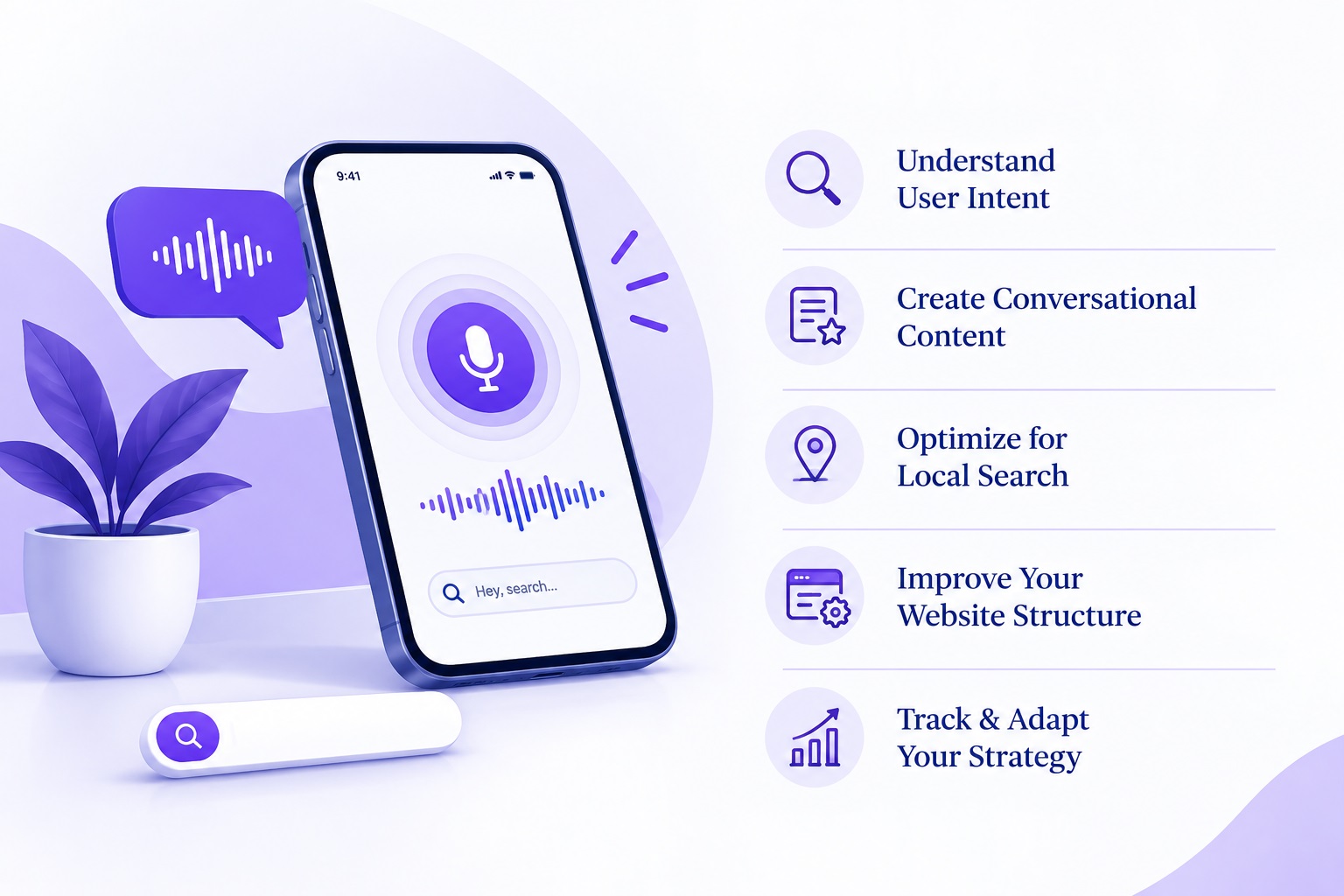
Voice search is changing how people discover businesses, find information and make purchasing decisions online. Instead of typing short phrases into a search engine, users increasingly ask questions in natural language through smartphones, smart speakers and voice-enabled assistants. For businesses that want to improve their online visibility, adapting to these changing search behaviours is an important part of a modern SEO strategy.
Voice Search SEO focuses on helping search engines understand website content and match it with spoken queries. In 2026, businesses should consider conversational search, local search intent, useful answers, mobile usability and AI-powered discovery when planning their digital marketing strategies.
For brands looking to remain competitive, voice search optimisation is not a completely separate discipline. It builds on established SEO principles while placing greater emphasis on natural language and clear, helpful information.
What Is Voice Search SEO?
Voice Search SEO is the process of optimising website content so it can effectively answer questions people ask through voice-enabled devices. These searches may involve requests for recommendations, business locations, product information, opening hours or explanations of a particular topic.
For example, someone might type “SEO company UK” into a search engine but ask a voice assistant, “Which is a professional SEO company in the UK that can help improve my website rankings?”
This difference highlights the importance of understanding user intent. Effective Voice SEO involves creating content that answers real questions rather than simply repeating popular keywords.
Voice Search Optimisation also relies on strong technical foundations, relevant content, clear page structures and a positive user experience. Although no technique guarantees placement in voice search responses, these practices can help search engines interpret and use your content more effectively.
Why Voice Search SEO Matters in 2026?
People expect quick, relevant answers when using voice-enabled technology. Businesses that provide accurate information and address specific customer needs can improve their chances of being discovered through relevant searches.
Voice search also overlaps with mobile search, local SEO and conversational interactions with AI-powered tools. A user may search for a nearby service, compare providers or ask a question before deciding which company to contact.
This makes Voice Search Marketing particularly relevant to service-based businesses, ecommerce brands and companies targeting customers in specific locations.
However, voice search should not be treated as an entirely separate source of guaranteed traffic. Its value lies in understanding how customers search and ensuring your website offers useful, accessible information wherever relevant search opportunities arise.
1. Focus on Natural Language and Conversational SEO
One of the most important elements of modern voice search is natural language. Spoken queries often sound like complete questions, whereas traditional typed searches may contain only two or three words.
Conversational SEO helps bridge this gap by aligning your content with the way people naturally communicate.
Start by identifying the questions your target audience asks before purchasing a product or hiring a service. For example, a business owner may search for “How can I improve my website’s Google rankings?” or “What does a professional SEO company do?”
Use these questions as inspiration for relevant headings and informative paragraphs. Provide direct answers before expanding on the subject with practical advice.
When planning how to optimise content for conversational search queries, prioritise clarity and usefulness. Avoid unnatural keyword repetition, complicated sentences and vague explanations.
2. Target the Right Voice Search Keywords
Keyword research remains an essential part of SEO optimisation. However, voice search keyword research should consider both traditional search terms and longer, question-based phrases.
Start with your main keywords, including Voice Search SEO, Voice Search Optimisation, Voice Search Marketing and Voice Search Keywords. Then expand your research to include variations that reflect specific customer needs.
Examples include:
- How to optimise your website for voice search in 2026
- Best voice search optimisation strategies for businesses
- How to rank higher in voice search results on Google
- Best keywords to target for voice search optimisation
- How to optimise website content for AI-powered voice search
These long-tail phrases can help you identify relevant content opportunities. Incorporate them where they naturally fit, including blog headings, explanatory paragraphs and FAQ sections.
The goal is not to include every keyword on a single page. Instead, select phrases that closely match the article’s subject and answer the intent behind each query.
3. Create Clear, Helpful Answers to Common Questions
People often use voice search to obtain a quick answer. Your website should make important information easy to find and understand.
Consider adding an FAQ section to relevant service pages and blog posts. Questions should reflect genuine customer concerns, such as how long SEO takes, what technical SEO involves or how local search optimisation works.
Answer each question directly, then provide additional context where necessary. Use descriptive headings, short paragraphs and logical formatting to help readers and search engines understand the information.
This approach supports your wider Voice Search Strategy and can improve the overall usefulness of your content.
Remember that structured data can help search engines interpret eligible information, but adding schema does not guarantee a featured snippet or voice assistant response.
4. Strengthen Local Voice Search Visibility
Local searches are particularly valuable for businesses serving specific towns, cities or regions. Users may ask for a nearby website designer, a trusted marketing agency or a professional service provider in their area.
To improve local SEO for voice search queries, maintain accurate business details across your website and relevant business directories. If eligible, claim and optimise your Google Business Profile with the correct business name, address, telephone number, website and service information.
Create useful location-specific pages when you genuinely serve those areas. Include relevant services, local customer needs and clear contact details rather than publishing repetitive pages that differ only by location name.
Local Voice Search works best when your website, business listings and supporting information consistently communicate what you offer and where you operate.
For service providers, local visibility can help attract potential customers who are actively looking for professional assistance.
5. Improve Website Speed, Mobile Usability and Technical SEO
A website must be accessible, usable and technically sound to support effective search performance. Mobile-friendly design is especially important because smartphones are commonly used for voice interactions.
Check that your website loads efficiently, displays correctly on different screen sizes and allows visitors to navigate without difficulty. Review Core Web Vitals, image optimisation, internal links, crawlability and indexing issues.
Use HTTPS, descriptive page titles and meaningful heading structures. Ensure important content is available to search engines and that technical errors do not prevent key pages from being discovered.
These improvements strengthen your overall SEO Optimisation efforts. They also support the broader user experience, regardless of whether visitors arrive through voice, typed searches or other discovery channels.
6. Optimise for Google Assistant, Siri and AI-Powered Search
Businesses should understand how their audiences use different search and assistant technologies. Learning how to optimise a website for Google Assistant and Siri begins with providing accessible, relevant and well-structured information.
Write content that addresses clear questions, use descriptive headings and keep important business details accurate. Support factual claims with credible sources where appropriate, and demonstrate relevant experience through practical examples and original insights.
As AI-powered search experiences develop, content should be useful beyond a single keyword or device. Understanding how to optimise website content for AI-powered voice search means focusing on context, accuracy and meaningful answers rather than relying on a particular technical trick.
No single optimisation method guarantees that an assistant will select your website. Continue monitoring organic search performance and update your content as customer needs and search technologies evolve.
7. Measure and Improve Your Voice Search Strategy
Voice search performance can be difficult to isolate because analytics platforms do not always identify whether a query originated from a spoken interaction.
Instead, measure relevant indicators such as organic impressions, clicks, search queries, local visibility, conversions and engagement. Google Search Console can help you identify the queries that bring users to your website, while analytics tools can show how visitors interact with your content.
Review question-based searches, improve pages that receive impressions but few clicks, and update information that has become outdated.
The best voice search optimisation strategies for businesses combine ongoing measurement with consistent improvements to content, technical SEO and customer experience.
How Webvizion Can Help Your Business Grow?
Webvizion is a professional SEO company in the UK helping businesses strengthen their online presence through strategic search engine optimisation. Our approach focuses on improving website visibility, addressing technical issues, developing relevant content and targeting keywords that align with your business objectives.
Whether you need technical SEO improvements, keyword research, content optimisation, local SEO or a comprehensive SEO strategy, our team can help you identify opportunities to improve your website’s search performance.
Voice search is one part of a wider digital visibility strategy. By combining strong SEO foundations with useful content and a better user experience, your business can build a more sustainable presence across evolving search platforms.
Ready to improve your website’s search visibility in 2026?
Contact Webvizion to discuss your SEO requirements and discover how a tailored SEO strategy can help your business reach the right audience.
Get started with Webvizion: https://webvizionglobal.com/contact/