Search engines are evolving beyond traditional search results. With AI-powered search experiences, Google AI Overviews and conversational platforms changing how people discover information, businesses need to make their website content easier for search engines to understand. This is where Structured Data for AI Search becomes an important part of a modern SEO strategy.
Structured data helps search engines interpret the meaning and context of information on a webpage. By implementing relevant Schema Markup, businesses can provide clearer information about their services, products, articles, organisations and frequently asked questions. Although structured data does not guarantee higher rankings or inclusion in AI-generated answers, it can help search engines interpret website content and make eligible pages suitable for enhanced search results.
For businesses looking to improve their online visibility, combining Structured Data SEO with high-quality content, technical SEO and Generative Engine Optimisation can create a stronger foundation for long-term organic growth.
What Is Structured Data in SEO?
Structured Data is a standardised way of describing information on a website so that search engines can interpret it more consistently. It adds machine-readable context to existing webpage content, helping search engines distinguish between different types of information.
For example, a webpage might mention a business name, its location, customer reviews, services and contact information. Without structured data, search engines must interpret these details from the page content. With suitable schema, the website can explicitly identify the organisation, its services and other relevant properties.
Schema.org provides a shared vocabulary for describing different types of entities and content. Common examples include Article, Organisation, LocalBusiness, Product, BreadcrumbList and Service.
Effective Schema SEO involves choosing appropriate schema types, implementing them accurately and ensuring they match the information users can actually see on the page.
How Does Schema Markup Help Search Engines Understand Content?
Understanding how schema markup helps search engines understand content is essential for businesses investing in Technical SEO. Search engines analyse multiple signals to determine what a webpage contains and how it relates to a user’s query.
Schema Markup provides additional context by identifying the entities and relationships described on a page. For example, Article schema can identify an article’s headline, author and publication date, while Organisation schema can describe a business and its official website.
This information can reduce ambiguity and help search engines interpret the page more accurately. However, structured data does not replace relevant content, internal linking, crawlability or other SEO fundamentals.
When schema is implemented correctly, it can also make a webpage eligible for certain rich results in Google Search. Eligibility does not guarantee that Google will display an enhanced result, and not every schema type generates a visible feature.
How Structured Data Improves AI Search Visibility?
AI Search platforms use different approaches to retrieve, interpret and present information. Search engines and AI-powered discovery systems may consider webpage content, relevance, authority and other signals when deciding which information to surface.
Understanding how structured data improves AI search visibility requires recognising that schema is a supporting signal rather than a shortcut to AI rankings.
Structured data can help clarify important information about your organisation, products, services and published content. This additional context can complement well-organised webpages and trustworthy information, making your website easier to interpret.
For example, an SEO agency can use appropriate Organisation and Service markup to describe its identity and the services presented on its website. An educational publisher can use Article schema to provide structured information about its guides and resources.
However, AI platforms do not all use structured data in the same way. Schema implementation alone cannot guarantee that a website will be cited by ChatGPT, Gemini or another AI-powered platform.
Best Schema Markup for AI Search Engines
Choosing the best schema markup for AI search engines depends on your website’s purpose and the content published on each page. Rather than applying every available schema type, select markup that accurately represents the visible information.
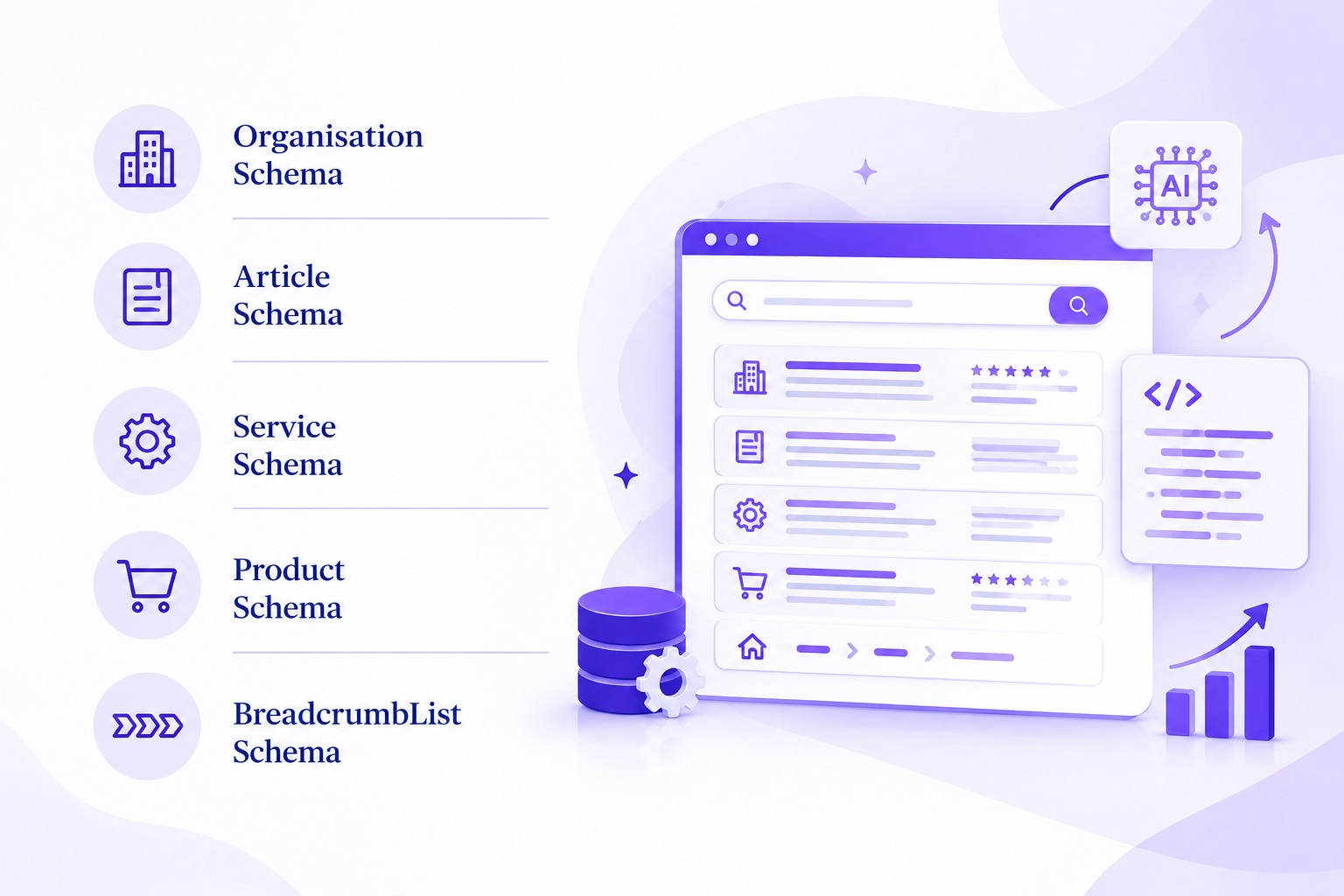
The following are some of the most useful structured data types for many business websites.
1. Organisation Schema
Organisation schema helps describe a business, including its name, official website, logo and other supported details. It can help establish consistent information about your brand across your website.
2. Article Schema
Article schema is useful for blog posts, guides and editorial content. Depending on the page, relevant properties may include the headline, author, publication date and featured image.
3. Service Schema
Service schema can describe a service offered by a business. It is particularly relevant to agencies providing SEO, website development, digital marketing and other professional services. Ensure the markup accurately reflects the service information displayed on the page.
4. Product Schema
Product schema can describe eligible products using relevant properties such as product name, description, price and availability. Product structured data is especially useful for ecommerce websites when implemented according to applicable search engine guidelines.
5. BreadcrumbList Schema
BreadcrumbList schema describes the breadcrumb navigation on a webpage. It can help search engines understand the page’s position within the website hierarchy.
These are among the best structured data types for AI search optimisation when they fit the actual page content. FAQPage and other schema types should only be used where appropriate, and their availability for enhanced search features depends on current search engine policies.
How to Implement JSON-LD Schema for SEO?
JSON-LD Schema is a widely recommended format for implementing structured data because it separates machine-readable information from the visible HTML content. This can make schema easier to maintain and manage on many websites.
If you want to understand how to implement JSON-LD schema for SEO, follow these steps:
- Step 1: Identify the page type. Determine whether the page represents an organisation, service, article, product or another supported entity.
- Step 2: Select the appropriate schema. Use the Schema.org vocabulary and follow the relevant search engine documentation to choose suitable properties.
- Step 3: Add accurate information. Include details that reflect the actual page content. Avoid inventing reviews, ratings, prices, authors or business information.
- Step 4: Implement the markup. Add JSON-LD to the page using your CMS, an SEO plugin or a controlled code implementation. Ensure the markup is accessible to search engines.
- Step 5: Test and monitor. Validate the structured data, review indexing reports and monitor organic search performance after implementation.
The goal is not to add as much schema as possible. It is to provide accurate, relevant and technically valid information that complements the page.
How Structured Data Supports Generative Engine Optimisation?
Generative Engine Optimisation (GEO) focuses on improving a brand’s visibility across AI-powered search and answer experiences. It involves producing useful content, demonstrating expertise, strengthening brand credibility and making information easy to discover and interpret.
Understanding how structured data supports Generative Engine Optimisation means viewing schema as one component of a broader strategy.
For example, a business can combine Organisation schema with detailed service pages, consistent brand information, informative blog content and relevant third-party mentions. Together, these elements can help create a clearer and more consistent online presence.
Businesses should also publish direct answers to common customer questions, use descriptive headings, maintain logical internal links and demonstrate real experience in their subject areas.
There is no universal schema implementation that guarantees inclusion in generative AI responses. GEO should therefore focus on improving content quality, accessibility, trust and discoverability rather than relying on markup alone.
Importance of Structured Data for Google AI Overviews
The importance of structured data for Google AI Overviews should be understood within Google’s broader search guidance. Google does not require special AI-specific schema to appear in AI Overviews, and implementing structured data does not guarantee inclusion.
Nevertheless, structured data can support the wider SEO foundations that help search engines understand webpages. Accurate markup, useful content, crawlable pages and a positive user experience all contribute to a well-maintained website.
Businesses should prioritise content that answers genuine user questions, provides reliable information and demonstrates subject knowledge. They should also follow Google’s general structured data policies and technical requirements.
Instead of treating schema as a direct ranking boost, use it to communicate accurate information and support eligibility for applicable search features.
How to Validate Schema Markup for Better SEO Performance?
Knowing how to validate schema markup for better SEO performance helps prevent technical errors and misleading structured data.
Start with Google’s Rich Results Test to check eligibility for supported rich results. Use the Schema Markup Validator to examine structured data according to Schema.org vocabulary. Google Search Console can also help identify certain structured data issues and provide information about search performance.
During validation, check that required properties are present, values use the correct formats and the markup matches the visible page content. Review pages after website redesigns, CMS updates or template changes to ensure that schema remains accurate.
Avoid adding unsupported properties, duplicating conflicting markup or marking up content that visitors cannot see when search engine guidelines prohibit it.
Remember that valid schema does not guarantee rich results or better rankings. Measure success through relevant indicators such as organic impressions, clicks, click-through rates, indexed pages and qualified enquiries.
Common Schema SEO Mistakes to Avoid
Several mistakes can limit the effectiveness of Structured Data SEO.
First, avoid using irrelevant schema types simply because they appear popular. Second, never create fake ratings, testimonials or product details. Third, ensure structured data is consistent with visible content and does not contain outdated business information.
Another common mistake is ignoring the rest of Technical SEO. Even well-implemented schema cannot compensate for important crawlability issues, poor page quality, broken internal links or an unclear website structure.
Businesses should also avoid assuming that the same markup produces identical results across every search engine and AI platform. Follow platform-specific guidance and update implementations as requirements evolve.
Improve Your AI Search Visibility with Webvizion
Structured data is an important consideration for businesses that want to strengthen their technical SEO foundations and prepare their websites for evolving search experiences. When combined with high-quality content, effective internal linking, brand authority and a well-structured website, schema can support a more comprehensive organic search strategy.
Webvizion is one of the leading SEO companies in the UK, helping businesses strengthen their online presence through SEO strategy, technical optimisation, content improvements and digital marketing services. For organisations looking to improve their visibility in traditional search results and explore Generative Engine Optimisation, a tailored approach can help identify opportunities and address technical weaknesses.
Rather than relying on schema alone, Webvizion focuses on the broader elements of website performance, search visibility and sustainable organic growth.
If your website needs better technical SEO, more relevant organic traffic or a stronger foundation for AI-powered search, explore the SEO services offered by Webvizion.
Ready to improve your website’s search visibility?
Visit Webvizion Global to explore its SEO services and discover how a strategic combination of technical optimisation, structured data and high-quality content can support your business growth.